
Back-to-Back PMOS: Series or Parallel?


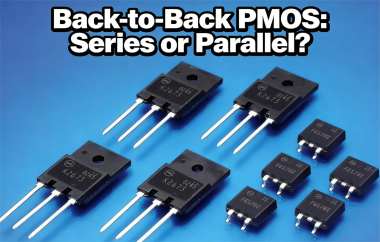
In power management, signal switching, and analog circuit design, the "back-to-back connection of two PMOS transistors" is a crucial circuit topology. Engineers often wonder about its electrical connection nature: is it series or parallel? This article aims to clarify this concept thoroughly. In reality, the electrical connection type is not solely determined by physical layout but depends on the specific circuit design intent and current path planning. A back-to-back connection provides flexibility to achieve certain circuit functions, allowing configuration as series to implement sequential signal processing or bidirectional blocking, or as parallel to extend current capacity and balance current flow. Understanding this fundamental distinction is essential for correctly analyzing and designing such circuits.
Catalog
II. Working Principle of Series Configuration
III. Typical Applications of Series Configuration
IV. Working Principle of Parallel Configuration
V. Design Considerations for Parallel Configuration
I. Defining Connection Type
Determining whether two devices are "series" or "parallel" should be based on how their terminals are connected to circuit nodes. If the endpoints of the two devices are connected sequentially along the current path (for example, the drain of device A connects to the source of device B, and the other ends of devices A and B connect respectively to the two ends of the circuit), the connection is series. If the corresponding terminals of the two devices are directly connected to the same nodes (for example, both sources connect to the same node and both drains also connect to the same node), the connection is parallel. It is important to note that whether the gates are connected together does not change the series or parallel property of the devices; connecting the gates simply shares a control signal without altering the electrical topology of the two devices.
II. Working Principle of Series Configuration
When the design goal requires cascading signal processing or achieving bidirectional shutdown, a series configuration is used. In this configuration, the conductive channels of the two PMOS transistors are connected in sequence. Its most notable application is in constructing an ideal bidirectional switch. Because each PMOS transistor contains an internal body diode oriented in a fixed direction, a single transistor cannot block reverse current when turned off. By connecting two transistors back-to-back in series, with their body diodes oriented oppositely, turning off both gates ensures that, regardless of the external voltage direction, one body diode is always reverse-biased, completely blocking current. This principle is widely used in battery protection circuits and reverse-current prevention circuits to ensure unidirectional controllability of current.
III. Typical Applications of Series Configuration
Classic applications of the series configuration include differential input pairs in precision analog circuits and fully isolated power switches. In differential pairs, two PMOS transistors with connected gates operate in the amplification region to amplify input differential signals, and their series current path is critical for common-mode rejection. In power path management, such as high-side load switches, two series PMOS transistors serve as the main switching devices, achieving complete electrical isolation between the power supply and the load, effectively preventing surge currents and voltage spikes during hot-plug events and improving system reliability.
IV. Working Principle of Parallel Configuration
When the circuit needs to handle larger currents or reduce conduction losses, a parallel configuration is used. In this case, the sources and drains of the two PMOS transistors are electrically connected, effectively forming a transistor with a wider channel. The primary purpose of parallel configuration is to increase current capacity; the total on-resistance is roughly half that of a single transistor, significantly reducing voltage drop and power loss when large currents flow. For example, in the output stage of a power conversion module or in motor driver circuits, using parallel PMOS transistors directly enhances current output capability while distributing thermal stress.
V. Design Considerations for Parallel Configuration
The main design challenge in parallel configuration is ensuring even current distribution between the two transistors. Due to minor variations in manufacturing, even two PMOS transistors of the same model may have slightly different threshold voltages and on-resistances. This can result in uneven current sharing, with one transistor carrying more current and overheating. Engineers rely on the positive temperature coefficient of the MOSFET's on-resistance to achieve dynamic current sharing: the transistor carrying more current heats up, its on-resistance rises, which naturally suppresses further current increase, forming a negative feedback balance. To ensure effective current sharing, matched devices should be selected, and the PCB layout should provide symmetrical thermal conditions for both transistors.
VI. Conclusion
In summary, the fundamental nature of a back-to-back PMOS connection—whether series or parallel—serves the specific circuit function. If bidirectional current control, signal cascading, or electrical isolation is required, a series configuration should be chosen, focusing on the body diode blocking characteristics and gate drive synchronization. If increasing current handling capacity and reducing on-resistance is the goal, a parallel configuration should be selected, with attention to both static and dynamic current sharing. In practical engineering, designers must first define the core performance requirements of the circuit, then determine the electrical nature of the back-to-back connection, and finally proceed with detailed parameter calculations and layout implementation. Mastering this duality is essential for designing efficient and reliable electronic systems.


