
BQ24725RGRR: Features, Specs & More


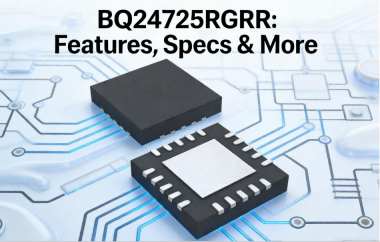
Power management remains a critical design challenge in modern electronics, especially in systems that rely on rechargeable lithium batteries. The TI BQ24725RGRR is a switching battery charger controller designed to address this challenge with flexibility, precision, and industrial-grade reliability. Widely adopted in portable and embedded systems, this device enables efficient charging across a wide voltage range while supporting high output current requirements. In this comprehensive article, we'll delve into the intricacies of the BQ24725RGRR, uncovering its definition, key features, specifications, applications, and a closer look at its manufacturer.
Catalog
BQ24725RGRR's Overview
The BQ24725RGRR is a high-performance switching battery charger controller developed for lithium-based battery systems. It supports both Li-Ion and Li-Polymer chemistries, making it suitable for a broad range of rechargeable applications. The device operates across a wide output voltage range from 1.024 V to 19.2 V, which allows it to accommodate various battery pack configurations. With a maximum charging current of 8 A, the controller is well-suited for high-power and fast-charging designs. Its compact VQFN package supports dense PCB layouts without compromising thermal performance.
Key Features
Let's delve into the standout features that make the BQ24725RGRR a standout in the world of electronics:
· The BQ24725RGRR supports Li-Ion and Li-Polymer battery chemistries.
· The device provides a maximum output charging current of up to 8000 mA.
· The output voltage range spans from 1.024 V to 19.2 V.
· The controller operates with a maximum supply voltage of 24 V.
· The device is designed for switching charger architectures to improve efficiency.
· The compact VQFN package enables space-constrained PCB designs.
· The no-lead package structure improves thermal and electrical performance.
· The controller supports surface-mount assembly for automated production.
Specifications
Now, let's take a closer look at the technical specifications that define the capabilities of the BQ24725RGRR:
Type | Parameter |
Type | Switching Battery Charger Controller |
Battery Type | Li-Ion|Li-Pol |
Minimum Operating Supply Voltage (V) | 0 |
Maximum Operating Supply Voltage (V) | 24 |
Output Voltage (V) | 1.024 to 19.2 |
Output Current (mA) | 8000(Max) |
Minimum Operating Temperature (°C) | -40 |
Maximum Operating Temperature (°C) | 85 |
Packaging | Tape and Reel |
Mounting | Surface Mount |
Package Height | 0.95(Max) mm |
Package Width | 3.65(Max) mm |
Package Length | 3.65(Max) mm |
PCB changed | 20 |
Standard Package Name | QFN |
Supplier Package | VQFN EP |
Pin Count | 20 |
Lead Shape | No Lead |
Applications
The TI BQ24725RGRR is ideal for applications that demand precise and efficient battery management. Key applications include:
· High-performance laptops and notebooks that require fast and safe battery charging.
· Portable devices including tablets and handheld instruments with Li-Ion/Li-Pol batteries.
· Industrial power management systems that operate in harsh temperature ranges.
· Power banks and UPS systems that need reliable and efficient energy storage.
· Embedded electronics projects where compact PCB design is essential.
BQ24725RGRR's Manufacturer
Texas Instruments (TI), established in 1930, is a global leader in semiconductor and technology solutions, known for its pioneering contributions to the electronics industry. Specializing in the design and manufacture of analog and digital circuits, microcontrollers, and processors, TI has played a pivotal role in shaping technological advancements across diverse sectors, including industrial, automotive, consumer electronics, and communication.
Conclusion
The TI BQ24725RGRR is a robust and versatile switching battery charger controller engineered for high-current Li-Ion and Li-Pol battery applications. With support for up to 8A charging current, wide voltage flexibility, and a compact 20-pin VQFN package, it is well-suited for laptops, embedded systems, and advanced portable devices. For designers seeking a proven, efficient, and scalable charging solution, the BQ24725RGRR remains a dependable choice in professional power management designs.


