
Is a Phototube the Same as a Photoresistor?


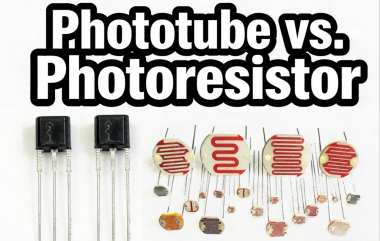
In the field of optical sensing within the electronics industry, many engineers, students, and tech enthusiasts often get confused or misled when searching for "Is a phototube a photoresistor?", especially in the context of Chinese online resources where the two terms are sometimes used interchangeably, causing misunderstandings. In reality, these two types of optical components differ fundamentally in their basic definitions, operating mechanisms, structural features, and performance characteristics. This article will systematically outline the core properties and differences between phototubes and photoresistors, starting from their fundamental concepts.
Catalog
3. Performance Characteristics
3. Performance Characteristics
III. Key Differences Between Them
I. What is a Phototube?
A phototube, also known as a photoelectric vacuum tube or photoemission tube, is an electronic device capable of converting incoming light signals into electrical signals. It primarily relies on the photoelectric effect to release and collect photoelectrons. Essentially, a phototube is a type of optical detector that converts light energy directly into an electric current through the electric field between the photocathode and the anode.
1. Working Principle
The working principle of a phototube is that when photons strike the surface of the photocathode, if the energy of the incoming photons exceeds the work function of the material, electrons on the surface gain enough energy to escape, forming photoelectrons. These photoelectrons are accelerated by the electric field and collected by the anode, producing an output current that is proportional to the light intensity. Since this mechanism depends on the energy and frequency of the photons, a phototube's response to incoming light is influenced not only by light intensity but also by wavelength.
2. Structural Features
The structure of a phototube is relatively complex and generally includes a photocathode, an anode, and a vacuum enclosure. The photocathode can be made of metal or semiconductor materials to improve absorption efficiency for specific wavelengths of light. The vacuum enclosure prevents photoelectrons from colliding with gas molecules during transit, which helps maintain detection efficiency. In a traditional phototube, the cathode and anode are arranged inside the sealed tube, and an external bias voltage is usually applied to create the accelerating electric field.
3. Performance Characteristics
Phototubes are highly sensitive to light signals, capable of detecting extremely weak light. They respond quickly, making them suitable for monitoring rapidly changing light conditions. The spectral response of a phototube depends on the cathode material, providing selective sensitivity to different wavelengths of light. In addition, phototubes can deliver relatively stable current output with low noise, making them well-suited for scientific instruments and precision measurement applications.
II. What is a Photoresistor?
A photoresistor, also known as a light-dependent resistor (LDR), photoconductive resistor, or photoconductor, is a passive semiconductor component whose resistance changes with incident light intensity. It relies on the photoconductive effect, and it is mainly used for light intensity detection and light-controlled circuits, serving as a light-sensitive switch or detection element.
1. Working Principle
The operating principle of a photoresistor is that when light strikes the semiconductor material, photons are absorbed. If the photon energy exceeds the bandgap of the material, electron-hole pairs are generated, significantly increasing the concentration of charge carriers in the material. This leads to higher conductivity, which macroscopically appears as a decrease in resistance. The stronger the light, the lower the resistance.
2. Structural Features
The structure of a photoresistor is very simple. Its main component is a thin film of photoconductive semiconductor material, commonly made from cadmium sulfide (CdS), cadmium selenide (CdSe), or lead sulfide (PbS). On both ends of this thin film, comb-shaped or serpentine ohmic contacts are created to increase the light-sensitive area and improve current collection efficiency. The entire component is typically housed in a resin or metal casing with a transparent window to protect the sensitive photoconductive layer.
3. Performance Characteristics
Photoresistors provide good light sensitivity and are responsive to changes in visible light intensity, but their response speed is relatively slow, making them unsuitable for fast-flashing or high-dynamic light environments. Their spectral response depends on the material used, with most being most sensitive to visible light. Additionally, their resistance is significantly affected by temperature changes, so temperature compensation or calibration needs to be considered in design.
III. Key Differences Between Them
When comparing phototubes and photoresistors, several technical aspects highlight their fundamental differences:
· Working Principle: Phototubes are based on the photoelectric effect, while photoresistors rely on the photoconductive effect.
· Structure: Phototubes consist of a photocathode and an anode and may include a vacuum tube; photoresistors are made from semiconductor materials with a simple structure.
· Sensitivity: Phototubes are more sensitive to light signals and can detect much weaker light.
· Response Speed: Phototubes respond faster than photoresistors, making them suitable for rapid detection and signal processing.
· Spectral Response: The spectral response of phototubes depends on the cathode material, while photoresistors' spectral response depends on the semiconductor material.
· Stability: Phototubes generally provide stable performance, whereas the resistance of photoresistors is more easily affected by temperature variations.
· Applications: Phototubes are used in applications requiring high sensitivity and fast response, while photoresistors are commonly used for measuring and controlling light intensity.
IV. Conclusion
In summary, "a phototube is not a photoresistor" is a clear and factual conclusion. Although both belong to the category of optical sensors, they differ significantly in their operating mechanisms, structural forms, performance characteristics, and real-world applications. Phototubes, with their high sensitivity and fast response based on the photoelectric effect, play a crucial role in advanced light detection fields. Photoresistors, on the other hand, offer simple structure, ease of use, and cost efficiency, making them widely used in light measurement and control circuits.


