
NCX2200GW,125: Features, Specs & More


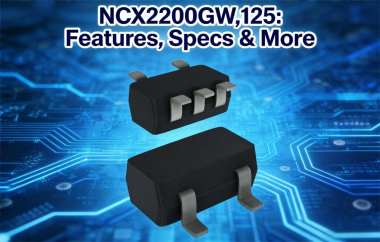
When designing compact and power-sensitive electronic systems, component selection can directly influence performance, reliability, and energy efficiency. The NCX2200GW,125, originally developed under Freescale Semiconductor and now part of the NXP Semiconductors portfolio, is a low-voltage, single-channel comparator engineered for precision signal comparison in space-constrained designs. In this comprehensive article, we'll delve into the intricacies of the NCX2200GW,125, uncovering its definition, key features, specifications, applications, and a closer look at its manufacturer.
Catalog
NCX2200GW,125's Overview
The NCX2200GW,125 is a low-voltage, single-channel comparator that supports rail-to-rail input and output operation across a wide supply range. It operates from as low as 1.3 V and up to 5.5 V, making it compatible with both legacy and modern low-power designs.
The device features a complementary output stage, enabling direct interfacing with digital logic circuits while maintaining low static power consumption. Its architecture prioritizes stable operation, moderate propagation delay, and low input bias current, which together support accurate voltage threshold detection in noise-sensitive environments.
Key Features
Let's delve into the standout features that make the NCX2200GW,125 a standout in the world of electronics:
· The device supports rail-to-rail input and output operation across its entire supply range.
· The comparator operates from a single supply voltage as low as 1.3 V.
· The device delivers a typical propagation delay of 800 ns.
· The output stage uses a complementary structure for reliable logic interfacing.
· The comparator achieves a typical common-mode rejection ratio of 70 dB.
· The device offers a typical power-supply rejection ratio of 80 dB.
· The design emphasizes ultra-low supply current consumption for battery-powered systems.
Specifications
Now, let's take a closer look at the technical specifications that define the capabilities of the NCX2200GW,125:
Type | Parameter |
Manufacturer Type | Low Voltage Comparator |
Number of Channels per Chip | 1 |
Rail to Rail | Rail to Rail Input/Output |
Typical CMRR (dB) | 70 |
Typical PSRR (dB) | 80 |
Maximum Propagation Delay Time (ns) | 800(Typ) |
Output Type | Complementary |
Maximum Operating Supply Voltage (V) | 5.5 |
Maximum Input Offset Voltage (mV) | 30@5.5V |
Minimum Single Supply Voltage (V) | 1.3 |
Maximum Single Supply Voltage (V) | 5.5 |
Maximum Input Bias Current (uA) | 0.000001(Typ)@5.5V |
Maximum Supply Current (mA) | 0.006(Typ)@5.5V |
Maximum Power Dissipation (mW) | 250 |
Power Supply Type | Single |
Minimum Operating Temperature (°C) | -40 |
Maximum Operating Temperature (°C) | 85 |
Packaging | Tape and Reel |
Mounting | Surface Mount |
Package Height | 1(Max) mm |
Package Width | 1.35(Max) mm |
Package Length | 2.25(Max) mm |
PCB changed | 5 |
Standard Package Name | SO |
Supplier Package | TSSOP |
Pin Count | 5 |
Lead Shape | Gull-wing |
Applications
The NCX2200GW comparator is well-suited for applications where low power consumption and reliable signal detection are critical.
· Battery-powered portable devices
· Voltage threshold and window detection circuits
· Sensor signal conditioning
· Power-management and supervision circuits
· Embedded control and monitoring systems
· Consumer electronics with tight PCB constraints
NCX2200GW,125's Manufacturer
Freescale Semiconductor, Inc., now seamlessly integrated into NXP Semiconductors, stands as a pioneering force in the semiconductor industry. Renowned for its cutting-edge technologies, Freescale Semiconductor played a pivotal role in shaping the landscape of embedded solutions and microcontrollers. With a commitment to innovation and a rich legacy, the company has consistently delivered high-performance semiconductor solutions, catering to a diverse range of industries. Following its merger with NXP Semiconductors, a global semiconductor powerhouse, the legacy of Freescale continues to thrive, fostering advancements in automotive, industrial, and IoT applications.
Conclusion
The NCX2200GW,125 low-voltage comparator is a practical and efficient solution for designers seeking precise signal comparison in compact, energy-efficient systems. With rail-to-rail input and output, ultra-low current consumption, and a robust operating temperature range, it fits seamlessly into modern embedded and portable electronics. For applications that demand reliability, efficiency, and minimal board space, this comparator remains a strong and relevant design choice.


