
Inductor vs Transformer: What's the Difference?


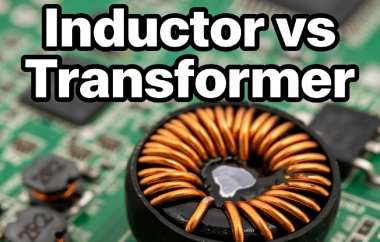
In the field of electronic components, inductors and transformers are both common passive devices based on the principle of electromagnetic induction, but they have clear differences in structure, function, and application. Understanding these differences is essential for designing, optimizing, and maintaining electronic products. This article starts with basic definitions and gradually compares the core differences between inductors and transformers.
Catalog
III. Differences Between Inductors and Transformers
I. What is an Inductor?
An inductor is a passive electronic component that can convert electrical energy into magnetic energy and store it. It is usually made by winding insulated wire into a coil and sometimes includes a magnetic core to strengthen the magnetic field. In circuits, it is typically represented by the letter “L.” The core function of an inductor is to resist changes in current through self-induction, store energy, and regulate alternating signals. Its applications include filters, oscillators, and voltage stabilization circuits. Inductors can effectively suppress sudden changes in current in AC circuits while offering very low impedance to DC. For this reason, they are widely used in switching power supplies, radio frequency circuits, and filter networks. The inductance value is determined by the number of coil turns, the material of the magnetic core, and the structural design, which are important parameters for evaluating an inductor’s performance.
II. What is a Transformer?
A transformer is a device built based on the principle of electromagnetic mutual induction. It mainly consists of a primary winding, a secondary winding, and a magnetic core. In circuit diagrams, it is typically represented by the letter “T.” The main function of a transformer is to induce voltage in the secondary winding through the changing magnetic field generated by the primary winding, allowing it to perform voltage conversion, current conversion, impedance matching, signal coupling, and circuit isolation. Transformers require AC to operate. Their applications include AC voltage stepping, switching power supplies, impedance matching, and signal isolation. Transformer design parameters include the turns ratio of the windings, the material of the magnetic core, and the power rating, all of which directly determine the output voltage, current, and energy transfer efficiency.
III. Differences Between Inductors and Transformers
Although both inductors and transformers are electromagnetic induction components, they differ significantly in structure and function.
First, in terms of structure, an inductor has only one winding, which is used to store magnetic energy and resist changes in current. A transformer, on the other hand, has at least two windings and transfers energy from the primary winding to the secondary winding through a magnetic core, allowing voltage or current to change.
Second, in terms of function, inductors are mainly used for energy storage, filtering, and controlling AC current changes, while transformers are primarily used to transmit energy, change voltage or current, and provide circuit isolation.
Third, regarding applications, inductors are commonly found in filter networks, oscillators, and switching power supplies, whereas transformers are mainly used in power conversion, voltage adaptation, signal coupling, and isolation protection.
In addition, inductors offer very low impedance to DC but significant impedance to AC signals, while transformers require AC operation to effectively transmit energy and change voltage.
In short, a transformer is a device that generates voltage in the secondary winding through electromagnetic induction to transfer energy, while an inductor only resists current changes and stores magnetic energy through self-induction. The fundamental difference lies in their function and purpose, not merely in their structure.
IV. Conclusion
Although both inductors and transformers belong to the category of electromagnetic induction components, they differ fundamentally in design, working principle, and application. Inductors store energy and regulate AC current changes through self-induction, while transformers induce voltage in the secondary winding through the changing magnetic field of the primary winding, enabling energy transfer as well as voltage, current, and impedance conversion.


