
What Are the Uses of Low-Power and High-Power Resistors?


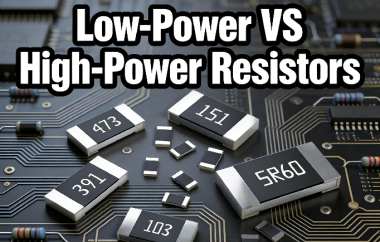
In the electronic components industry, resistors are one of the most basic and essential components, and they are not only used to limit current, divide voltage, and condition signals, but also play an important role in energy dissipation and circuit protection. Depending on their power-handling capabilities, resistors can be classified into low-power resistors and high-power resistors, and this article will provide a detailed analysis of the definition, characteristics, and applications of both types.
Catalog
I. What Is a Low-Power Resistor?
II. Characteristics of Low-Power Resistors
III. Applications of Low-Power Resistors
IV. What Is a High-Power Resistor?
V. Characteristics of High-Power Resistors
VI. Applications of High-Power Resistors
I. What Is a Low-Power Resistor?
A low-power resistor refers to a resistor with a relatively low rated power that is typically used for controlling and limiting small currents, and its typical rated power is generally below 1 watt. These resistors are compact in size and suitable for embedding in various electronic circuits. Low-power resistors can take the form of standard resistors, metal film resistors, or potentiometers, and their design focuses on providing stable resistance values and high accuracy while safely controlling current and processing signals within a limited power range. Due to their low power capacity, low-power resistors are suitable for applications such as signal conditioning, voltage division, current limiting, and temperature compensation.
II. Characteristics of Low-Power Resistors
Low-power resistors are characterized by high accuracy, low power consumption, small size, and suitability for low-power applications. Firstly, they usually have precise resistance values, which ensures the accuracy and stability of signals in the circuit. Secondly, because their power capacity is limited, the resistor itself consumes little energy, which helps reduce energy waste and improve circuit efficiency. In addition, low-power resistors are small and lightweight, making them easy to embed in circuit boards and various electronic devices, saving space and enhancing design flexibility. Their main applications are focused on low-power circuit protection, signal conditioning, and temperature compensation.
III. Applications of Low-Power Resistors
Low-power resistors have a wide range of applications, and several typical use cases are highlighted below.
1. Circuit Protection: Low-power resistors can be used for circuit protection, such as overcurrent protection and overvoltage protection. When connected in a circuit, the resistor limits current or voltage if it exceeds a set threshold, protecting other electronic components from damage.
2. Signal Conditioning: Low-power resistors can be used in signal conditioning circuits, such as filters, amplifiers, and feedback circuits. Adjusting the resistor's value can change the signal characteristics in the circuit, such as increasing or decreasing signal amplitude and adjusting frequency response.
3. Temperature Compensation: Low-power resistors play an important role in temperature compensation circuits. Because a resistor's value can fluctuate with temperature, in certain applications, low-power resistors are combined with thermistors or other components to offset temperature effects and ensure circuit stability.
IV. What Is a High-Power Resistor?
A high-power resistor is designed to withstand and dissipate large amounts of power, and its rated power typically ranges from several watts to hundreds of watts or more, making it suitable for high-current, high-power circuit environments. High-power resistors generally have a larger size and excellent heat dissipation structure, and some components require additional heat sinks or forced cooling, such as air or liquid cooling, to enhance thermal management. They play a key role in power control, current limiting, and energy absorption, and they are indispensable components in power circuits, industrial equipment, and high-power electronic systems.
V. Characteristics of High-Power Resistors
High-power resistors are characterized by high power capacity, good thermal conductivity, and stable DC performance. They can handle large current loads and are designed with specific materials and structures to effectively dissipate heat, preventing damage from overheating. At the same time, high-power resistors maintain stable resistance values over long periods of operation and are less affected by temperature fluctuations, ensuring the overall reliability of the circuit. High-power resistors typically use wire-wound, metal oxide film, or ceramic structures to improve heat resistance and thermal management, meeting the requirements of industrial and high-power electronic applications.
VI. Applications of High-Power Resistors
High-power resistors are also widely used in various fields, and some typical applications are highlighted below.
1. Power Circuits: High-power resistors are commonly used in power circuits for power transfer, distribution, and control. For example, in power supply circuits, they can serve for load simulation and fault protection.
2. Heat Dissipation Systems: High-power resistors are used in heat dissipation systems to control and limit current, preventing electronic devices from overheating. They generally have excellent thermal conductivity and can efficiently release heat through their heat-dissipating structure.
3. Welding Machines and Motors: High-power resistors are also used in welding machines and motors, as well as other high-power equipment, to regulate and limit current.
VII. Conclusion
In summary, low-power resistors and high-power resistors serve different functions in electronic circuits. Low-power resistors are mainly used for controlling small currents and signal processing and are suitable for circuit protection, signal conditioning, and temperature compensation. High-power resistors, on the other hand, are used for controlling large currents and dissipating energy and are widely applied in power circuits, heat dissipation systems, and high-power equipment. Choosing and applying the right type of resistor is crucial for improving circuit performance, reliability, and overall system efficiency.


