
Thin vs Thick Film Resistors: What's the Difference?


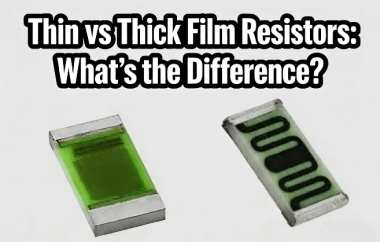
In the electronic components industry, thin film resistors and thick film resistors are the two most common and widely used types of resistive products, and they perform essential functions such as precise current limiting, voltage division, and signal conditioning in a wide range of electronic systems. Although both belong to the category of film resistors, clear differences exist in accuracy, stability, cost, and application areas due to variations in manufacturing processes and material structures.
Catalog
II. Differences in manufacturing processes
III. Differences in performance characteristics
IV. Differences in application scope
I. What is a resistor?
A resistor is a passive electronic component that limits or regulates the flow of electric current through its inherent resistance, and its main functions include current limiting, voltage division, biasing, load matching, and signal conditioning. Almost all electronic devices rely on resistors, from basic consumer electronics to industrial control systems, communication equipment, and precision instruments, where resistors play a key role in ensuring stable circuit operation. As the two primary forms of film resistors, thin film resistors and thick film resistors each offer distinct advantages in different applications, which makes understanding their differences important for improving circuit reliability and overall performance.
II. Differences in manufacturing processes
The most fundamental difference between thin film resistors and thick film resistors lies in how they are made. Thin film resistors are typically produced using vacuum deposition or sputtering processes to form an extremely thin and uniform layer of metal or metal compound on an insulating substrate such as ceramic, after which the resistance value is precisely adjusted through photolithography or laser trimming. Because the film layer is very thin and the process control is highly precise, thin film resistors offer excellent consistency and stability. In contrast, thick film resistors are manufactured using a screen-printing process, where a paste composed of conductive materials, glass phases, and organic binders is printed onto the substrate and then fired at high temperature to form the resistive layer, resulting in a much thicker film and a simpler production flow that is better suited for high-volume manufacturing.
III. Differences in performance characteristics
From a performance perspective, thin film resistors generally provide higher resistance accuracy and lower temperature coefficients, with typical tolerances reaching 0.1 percent or even better, minimal resistance change over temperature, strong long-term stability, and low noise levels, making them well suited for circuits with strict signal quality requirements. Thick film resistors, due to their granular material structure and process characteristics, usually offer tolerances in the range of 1 to 5 percent and have relatively higher temperature coefficients, but they perform well in terms of environmental robustness and manufacturing flexibility. In addition, when it comes to power handling, each type has its own focus, with thin film resistors emphasizing precision and stability, while thick film resistors meet a wider range of power needs in standard applications at a more competitive cost.
IV. Differences in application scope
Based on these performance differences, thin film and thick film resistors naturally serve different roles across application fields. Thin film resistors, with their high precision, low drift, and excellent consistency, are widely used in precision instruments, communication equipment, medical electronics, test and measurement systems, as well as analog and high-speed circuits where signal integrity is critical. Thick film resistors, supported by their cost advantages and mature mass-production processes, have become the mainstream choice in consumer electronics, home appliances, power management systems, electric vehicles, and automotive electronics, where cost control and reliability often matter more than extreme precision.
V. Conclusion
Overall, thin film resistors and thick film resistors show clear and well-defined differences in manufacturing processes, performance characteristics, and application scenarios. Thin film resistors stand out in terms of accuracy, stability, and consistency, making them ideal for applications with higher performance requirements, while thick film resistors dominate the general electronics market thanks to their lower cost, efficient production, and broad usability. In real-world component selection, engineers should evaluate specific circuit needs, performance targets, and budget constraints together in order to fully leverage the technical strengths of each resistor type.


