
Auxiliary vs Intermediate Relay: What's the Difference?


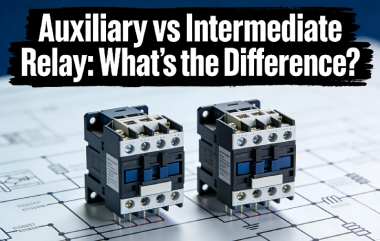
In electronic components and automation control systems, relays are an important type of control device used for signal transmission, contact expansion, and logic control. Among them, auxiliary relays and intermediate relays are two commonly used types. Although they are based on similar working principles, there are clear differences in concept, structure, application, and implementation. Below is a detailed explanation of the differences between auxiliary relays and intermediate relays.
Catalog
III. Different classifications
I. Different concepts
Intermediate relays are mainly used in relay protection and automatic control systems to transmit intermediate signals within control circuits, while also increasing the number and capacity of contacts. In practical circuits, they are responsible for signal amplification, contact expansion, and control isolation, and they belong to hardware-level control components.
Auxiliary relays, on the other hand, are “virtual relays” implemented through software logic. They cannot directly receive external input signals, nor can they drive external loads. They are used as internal status flags in relay control systems or PLC programs and function as logical-level intermediate relays to represent program states or logic conditions.
II. Different structures
The structure of an intermediate relay usually includes components such as a coil, iron core, armature, contact springs, and return springs. When the coil is energized, the armature is attracted to the iron core and drives the contacts to move, causing normally open contacts to close and normally closed contacts to open. When the coil is de-energized, the armature and contacts return to their initial positions, preparing for the next operation. This electromagnetic structure ensures reliable signal transmission and contact switching in real circuits.
Auxiliary relays do not have any mechanical structure, and their functions are realized through software logic. They do not rely on iron cores, armatures, or contact springs, but instead represent logic conditions through internal status flags within a PLC or control program. As a result, auxiliary relays cannot directly receive external signals or drive actual loads, and their function depends entirely on program logic.
III. Different classifications
Intermediate relays can be classified based on their working principles and construction, including:
· Electromagnetic intermediate relays, which rely on electromagnetic force generated by an energized coil to drive the armature and achieve contact closing or opening.
· Static intermediate relays, which use electronic components or small solid-state relays to achieve fast switching and high reliability, and are considered a new-generation replacement for traditional intermediate relays.
Auxiliary relays are classified based on their logic functions and usage, including:
· General-purpose auxiliary relays, which are used in various protection and automatic control circuits.
· Battery-backed or latching auxiliary relays, which are used to retain system status during momentary power interruptions.
· Special auxiliary relays, which are used in PLC systems to represent specific program states or logic conditions and typically support up to 256 logic points.
IV. Conclusion
Overall, although intermediate relays and auxiliary relays both fall under the relay category, they differ significantly in structure, implementation method, and application scenarios.
· Intermediate relays are hardware components mainly used for current expansion, contact increase, and signal transmission, and they play a direct role in control circuits.
· Auxiliary relays are software-based logic markers mainly used to represent states in PLC programs or control logic, and they do not directly drive circuits or loads.
A clear understanding of the characteristics and differences between these two types of relays helps engineers make proper selections in industrial automation design, electrical control systems, and PLC programming, ultimately improving system reliability and maintainability.


