
What's the Difference Between EMR and SSR?


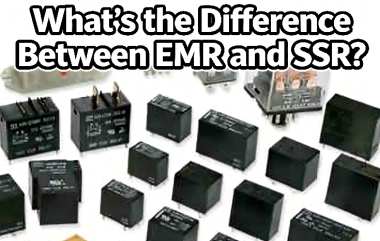
In the electronic components industry, relays are essential control devices used to automatically switch and manage electrical circuits. Engineers and electronics enthusiasts often encounter two main types of relays when designing control systems: Electromechanical Relays (EMR) and Solid State Relays (SSR). Although both types of relays serve the purpose of controlling circuits, they differ significantly in structure, operating principles, performance characteristics, and applicable scenarios.
Catalog
I. What is an Electromechanical Relay?
II. What is a Solid State Relay?
III. Electromechanical Relays vs. Solid State Relays
I. What is an Electromechanical Relay?
An electromechanical relay is a traditional mechanical relay whose core components include an electromagnetic coil, armature, contacts, and springs. When a control current flows through the coil, the coil generates a magnetic field that attracts the armature, causing the mechanical contacts to close or open, which in turn controls the connection of the load circuit. Electromechanical relays are characterized by their simple structure, low manufacturing cost, and ability to handle high currents and high-voltage loads. As a result, they are widely used in industrial control systems and traditional electrical equipment. Their operation depends on mechanical movement, which makes them prone to wear and limited lifespan under high-frequency switching or frequent operation.
II. What is a Solid State Relay?
A solid state relay is a type of relay that uses semiconductor components to control the switching of circuits, without any moving mechanical parts. Its main components include a control input isolator (such as an optocoupler), a trigger driver circuit, and semiconductor switching devices (such as thyristors, MOSFETs, or transistors). When a control signal is applied to the input, the driver circuit triggers the semiconductor switch, allowing the load circuit to conduct or disconnect. Because there are no mechanical parts, solid state relays respond quickly, operate silently, resist vibration and shock, and generally have a much longer lifespan than electromechanical relays.
III. Electromechanical Relays vs. Solid State Relays
The following is a systematic comparison of the two types of relays across several key dimensions:
1. Operating Principle
Electromechanical Relays: These rely on electromagnetic force to move mechanical contacts in order to open or close a circuit. The movement of the mechanical contacts is central to the switching operation.
Solid State Relays: These use semiconductor devices (such as transistors or bidirectional thyristors) as the switching element and respond to control signals electronically without any mechanical movement. SSRs usually use optocouplers to isolate the control circuit from the load circuit.
2. Noise and Electromagnetic Interference
Electromechanical relays typically produce audible clicking sounds during operation and may generate arcs and electrical noise, causing electromagnetic interference. In contrast, solid state relays do not produce arcs, mechanical vibrations, or noise, and they do not generate electromagnetic fields that affect nearby power lines. Therefore, SSRs are more suitable in applications where low noise and minimal electromagnetic interference are required.
3. Speed and Response Time
Electromechanical relays have slower response speeds because the mechanical components require time to move and switch. Solid state relays respond much faster and can switch circuits in just a few microseconds. This rapid response makes SSRs ideal for high-speed operation and precise timing applications.
4. Lifespan and Reliability
The mechanical contacts of electromechanical relays wear down over repeated switching, resulting in a relatively shorter lifespan. Solid state relays, on the other hand, have superior reliability and longevity because they contain no mechanical parts, only electronic and semiconductor components.
5. Safety Considerations
When electromechanical relays switch power or high-voltage circuits, arcs may occur, potentially causing fires or other safety hazards. Solid state relays do not generate arc discharges, which eliminates these potential safety risks.
6. Environmental Temperature
Electromechanical relays are sensitive to ambient temperature, and extreme high or low temperatures may affect their performance. The performance of solid state relays is much less affected by temperature, and their reliability is generally independent of environmental temperature conditions.
IV. Conclusion
Both electromechanical relays and solid state relays have their advantages and disadvantages, and the choice between them should be based on the specific application and design requirements. If a system requires high-speed response, low noise, long lifespan, and high reliability, a solid state relay is the better option. If a system is cost-sensitive, handles high loads, or does not require fast response, an electromechanical relay remains a reliable choice. In practical engineering, understanding the characteristics and differences of both types of relays can help designers optimize control systems and improve device stability and safety.


