
How to Choose and Use Optocouplers?


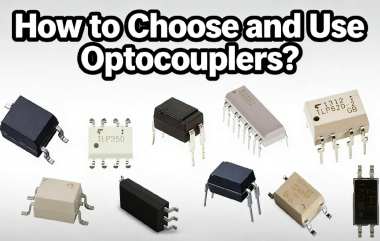
In modern electronic devices, an optocoupler is a key component that converts light signals into electrical signals. It uses an internal light-emitting diode and a photosensitive transistor to achieve signal isolation and transmission, playing an important role in suppressing electrical noise, protecting circuits, and transmitting signals. This article will provide a systematic guide on how to choose and use optocouplers.
Catalog
II. How to Choose an Optocoupler?
III. How to Use an Optocoupler?
I. What is an Optocoupler?
An optocoupler is an electronic component that uses a light signal as a medium to achieve electrical isolation between the input and output. Inside, it mainly consists of a light-emitting diode (LED) and a photosensitive receiver, such as a phototransistor or photodiode. The input current drives the LED to emit light, and the output component receives the light and converts it back into an electrical signal, completing the signal transmission from electrical → light → electrical, without any direct electrical connection in between, thus achieving isolation.
Electrical isolation is crucial for transmitting signals between high-voltage and low-voltage sides, for safety protection, and for improving anti-interference capability. It prevents noise, high voltage, and other disturbances from feeding back to the control side.
II. How to Choose an Optocoupler?
Selecting an optocoupler is not as simple as picking a component model. It requires considering product specifications, circuit environment, package type, and cost.
1. Understand Product Specifications
Before choosing an optocoupler, you need to know its key performance parameters, such as maximum operating voltage, operating frequency, and photoelectric conversion efficiency. These factors determine whether the optocoupler can reliably perform in a specific application.
2. Determine the Working Environment
The environment in which an optocoupler operates affects its lifespan and performance. In high-temperature, high-humidity, or high-interference environments, you should select a model that can withstand heat, resist moisture, or resist interference.
3. Choose the Right Package Type
Optocouplers come in various package types, including DIP (dual in-line package), SOP (small outline package), and SMD (surface-mount package). Select the package that best suits your manufacturing process and installation requirements.
4. Consider Cost Factors
Prices can vary significantly between brands and models. When choosing an optocoupler, consider performance, reliability, and cost together, and select a product with a good balance of value and quality to ensure the project remains cost-effective.
III. How to Use an Optocoupler?
Selecting the right model is only the first step. Proper circuit design and setup are equally important.
1. Connect the Circuit
Correctly connecting the input and output circuits of the optocoupler is critical. Typically, the LED's anode is connected to the positive supply, the cathode to the negative supply, and the optical output is connected to the circuit that needs to receive the signal.
2. Control the Light Source
The LED serves as the light source for the optocoupler, and its operating current and voltage must meet the specifications. You can use a series current-limiting resistor or a conversion circuit to regulate the current and voltage, ensuring the LED emits light steadily.
3. Photosensitive Effect
When light falls on the photosensitive transistor, it generates a current or voltage signal based on the photosensitive effect. This signal can be processed or filtered using resistors, capacitors, or other components to meet circuit requirements.
4. Protection Measures
To extend the lifespan of the optocoupler, protective measures should be implemented, such as power supply filters, overvoltage protection, and overcurrent protection circuits, preventing damage or performance degradation.
5. Testing and Debugging
Before using the optocoupler in a live circuit, it should be tested and debugged. You can use an oscilloscope or a multimeter to check the input and output signals, ensuring it operates correctly and meets the design requirements.
IV. Conclusion
Choosing and using an optocoupler requires considering product specifications, working environment, package type, and cost. In practical applications, attention should be paid to circuit connections, light source control, signal handling, protective measures, and testing. By selecting the right model and using it properly, an optocoupler can reliably convert light signals into electrical signals while effectively providing circuit isolation, signal transmission, and electrical noise suppression.


