
Linear vs Nonlinear Optocouplers: What's the Difference?


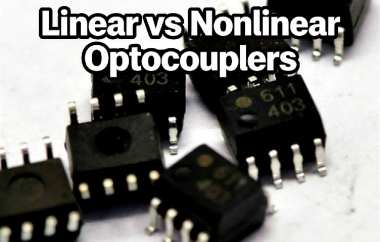
In the field of electronic components and power control, optocouplers appear in almost all circuits that require electrical isolation. From industrial power supplies and home appliance control to communications and instruments, optocouplers take on the core task of “isolating strong and weak electricity and ensuring reliable signal transmission.” When selecting components, engineers often face a key question: what exactly is the difference between linear optocouplers and nonlinear optocouplers? Can they replace each other? If the wrong type is chosen, it may slightly affect signal accuracy at best, or at worst cause oscillation in switching power supplies and reduce the equipment’s anti-interference ability. This article provides a systematic analysis from the aspects of basic definition, classification, key differences, and typical applications.
Catalog
II. Classification of optocouplers
III. The difference between nonlinear optocouplers and linear optocouplers
I. What is an optocoupler?
An optocoupler, also known as an optical isolator, optical coupler, or photoelectric isolator, is a semiconductor device that uses light signals to transmit information between input and output in order to achieve electrical isolation. Its typical structure consists of a light-emitting diode (LED) and a photosensitive receiver such as a phototransistor or photodiode. The electrical signal at the input drives the LED to emit light, the optical signal passes through a transparent insulating medium to the receiving end, and the photosensitive device then converts it back into an electrical signal, completing the “electric-light-electric” conversion and realizing isolation and signal transmission. Since there is no electrical connection between input and output, optocouplers have excellent electrical isolation and strong resistance to electromagnetic interference.
II. Classification of optocouplers
From the perspective of industry applications, the most important way to classify optocouplers is by transmission characteristics, and they can be divided into two major categories:
Nonlinear optocouplers: their current transfer characteristic curve shows obvious nonlinearity, and the output does not change proportionally with the input current, so they are mainly used for the isolation of switching or digital signals.
Linear optocouplers: their transfer characteristic curve is close to a straight line, and within the small-signal range they have a good proportional relationship, allowing them to transmit analog quantities or feedback control signals more accurately.
This classification directly determines the role of an optocoupler in a circuit, whether it acts as a “digital switch-type isolator” or as an “analog linear transmission device.”
III. The difference between nonlinear optocouplers and linear optocouplers
Optocouplers are very common in circuits, and their function in circuits is to provide isolation and perform photoelectric conversion, and among the types of optocouplers there are linear optocouplers and nonlinear optocouplers. Although they are all optocouplers, what is the difference between these two types? How can they be distinguished? The following explanation is given from the perspective of practical applications.
The current transfer characteristic curve of a nonlinear optocoupler is nonlinear, and this type of optocoupler is suitable for the transmission of switching signals but not for transmitting analog quantities. For example, the 4N series optocouplers belong to nonlinear optocouplers. These devices have a simple structure and low cost and are widely used in digital circuits and logic control, but they cannot guarantee a proportional relationship between input and output.
The current transfer characteristic curve of a linear optocoupler is close to a straight line, and it performs well with small signals, allowing isolation control with linear characteristics. The commonly used 817 series optocouplers in switching power supplies belong to linear optocouplers. Because they have good linearity and can stably transmit feedback signals, they have greater advantages in analog circuits that require precise control.
The optocoupler commonly used in switching power supplies is the linear optocoupler. If a nonlinear optocoupler is used, it may cause the oscillation waveform to deteriorate, and in serious cases parasitic oscillation may occur, making an oscillation frequency of several kilohertz become modulated by low-frequency oscillations of tens to hundreds of hertz in sequence. The consequence of this is that for color TVs, color monitors, VCDs, DCDs, and so on, interference will appear on the image screen, and at the same time the load capacity of the power supply will decline.
In the maintenance of switching power supplies for color TVs and monitors, if the optocoupler is damaged, it must be replaced with a linear optocoupler. Common four-pin linear optocouplers include PC817A–C, PC111, TLP521, and so on, and common six-pin linear optocouplers include LP632, TLP532, PC614, PC714, PS2031, and others. From this it can be seen that nonlinear optocouplers cannot be used in the feedback circuit of switching power supplies, otherwise the stability and reliability of the whole machine will be directly affected.
IV. Conclusion
Overall, although both linear optocouplers and nonlinear optocouplers belong to the category of optoelectronic couplers, they have clear divisions in transmission characteristics and application fields. Nonlinear optocouplers are more suitable for the isolation of digital and switching signals, while linear optocouplers are the core devices for analog feedback and switching power supply control. In the actual design and maintenance of electronic products, components must be selected correctly according to circuit functions, and especially in the feedback loop of switching power supplies, linear optocouplers should be strictly used for replacement and design. Only by fully understanding the difference between the two can the electronic system be ensured to have good anti-interference capability and long-term stable working performance.


