
MLCC Spot Prices Jump 20%


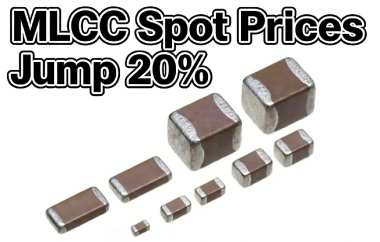
According to Taiwanese media reports, the passive components market is entering another round of price increases. After last year's rise in tantalum capacitors and the earlier hikes in chip resistors and ferrite beads, multilayer ceramic capacitors (MLCCs)—the most widely used passive component—are now seeing higher quotations. Several mainland China channel partners have begun lifting MLCC spot prices, with increases expected to reach around 20 percent. Market watchers believe that leading manufacturers such as YAGEO Corporation and Walsin Technologies are also likely to follow with higher spot prices, which may later extend to contract pricing.
With all four major passive component categories—tantalum capacitors, chip resistors, ferrite beads, and MLCCs—now on an upward trend, the industry is optimistic about revenue growth for related manufacturers. Among Taiwanese companies, YAGEO holds a dominant position with a full product portfolio and the largest market share, placing it in a favorable position to benefit first from the recovery.
Manufacturers typically avoid commenting publicly on price movements. Looking back, tantalum capacitors were the first to rise as demand from AI server racks surged and supply struggled to keep pace. Known for high temperature tolerance and stability, tantalum capacitors were traditionally used in military and aerospace applications. The rapid adoption of these devices in high-value AI servers by cloud service providers quickly disrupted supply and demand balance. For example, KEMET, part of the YAGEO Group, has implemented two rounds of price increases of 20–30 percent for large polymer tantalum capacitors used in servers, setting a benchmark for the broader passive component sector.
As delivery times for tantalum capacitors have stretched and prices climbed, system designers have started to adjust component configurations, significantly increasing MLCC usage and creating favorable conditions for MLCC price growth. MLCCs are valued for their small size, high-frequency performance, long lifespan, and reliability, making them essential in voltage stabilization, decoupling, filtering, and signal integrity circuits. AI servers and accelerator cards, which operate at high computing density and power consumption, require far more MLCCs per unit than conventional servers, turning them into critical building blocks for stable system operation.
To reduce over-reliance on tantalum capacitors, some power module designs have shifted to a mixed approach that combines tantalum capacitors with MLCCs, helping to spread supply risk and control costs. Mainland distributors are already reporting a wave of urgent orders, with spot prices for certain high-capacitance, automotive-grade, and industrial-grade MLCCs climbing 10–20 percent.
Industry analysts believe that, supported by long-term AI demand, MLCCs are no longer simply catching up with other components but are entering a phase of structural demand expansion. At YAGEO, tantalum capacitors remain the largest revenue contributor at roughly 18–22 percent, followed by MLCCs at 18–20 percent and chip resistors at about 11–13 percent, with magnetic components and other products making up the remainder.


