
How to Safely Charge and Protect Farad capacitors?


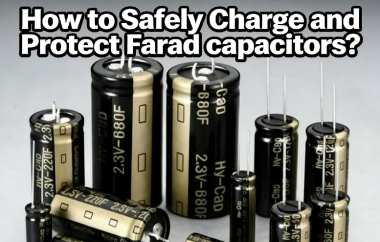
Farad capacitors, also known as supercapacitors, are electronic components with high charge storage capacity, fast charging and discharging speeds, high power density, and long lifespan. They have become essential components in modern electronics, energy storage systems, automotive starting applications, and renewable energy solutions due to their fast response and stable performance. However, if they are not handled properly during charging and discharging, or if effective protection is lacking, the capacitors can be damaged or their lifespan can be shortened. Therefore, understanding the correct methods for charging and discharging Farad capacitors, as well as implementing proper protection strategies, is critical for extending their lifespan and ensuring system safety. This article provides a detailed explanation covering basic concepts, charging methods, discharging methods, and protective measures.
Catalog
IV. Charging and Discharging Protection
I. What is a Farad Capacitor?
A Farad capacitor is a high-capacity energy storage component that operates based on the electrochemical double-layer or pseudocapacitance effect, storing charge at the interface between the electrodes and the electrolyte. Compared to traditional capacitors, Farad capacitors have several distinctive characteristics: large capacitance, fast charge and discharge speed, long cycle life, high power density, and a wide temperature operating range. Since the voltage rating of a single unit is generally low (usually between 2.5 and 2.7 V), multiple units often need to be connected in series for high-voltage applications. This requires careful management and protection of factors such as voltage balancing, overvoltage, overcurrent, and temperature during use. Farad capacitors are widely used in backup power supplies, instantaneous energy compensation, electric vehicle starting, and renewable energy storage, making them indispensable components for highly reliable electronic systems.
II. Charging Methods
When charging Farad capacitors, voltage, current, and charging method must be properly controlled to ensure safety and long-term performance:
Voltage and Current Control: During charging, it is important to control both the current and the voltage to avoid overcurrent and overvoltage. Generally, it is safe to keep the charging voltage at around 80% of the rated voltage, while limiting the current to about 10% of the rated current.
Charging Methods: Farad capacitors can be charged using either constant voltage (CV) or constant current (CC) methods. In constant voltage charging, the voltage remains stable while the current gradually decreases. In constant current charging, the current remains stable while the voltage gradually rises. The choice between these methods depends on the specific application and conditions.
Charging Time: The charging time for a Farad capacitor is usually around 1 to 2 hours, depending on the capacitance and charging method used. During charging, frequent charge and discharge cycles should be avoided, as they can reduce the capacitor’s lifespan.
III. Discharging Methods
Discharging Farad capacitors also requires proper procedures to prevent damage or performance degradation:
Discharge Forms: Farad capacitors can be discharged either through self-discharge or through an external circuit. Self-discharge occurs when the capacitor’s terminals are shorted, allowing charge to be released through its internal resistance. External discharge involves connecting the capacitor to a resistor or load, releasing charge in a controlled manner through the resistor or load.
Discharge Time: The discharge time for a Farad capacitor is typically between 1 and 2 minutes, depending on the capacitance and the load. During discharge, the capacitor should not be fully discharged, as complete discharge can negatively affect its lifespan.
IV. Charging and Discharging Protection
To ensure safe operation and extend the lifespan of Farad capacitors, protective measures during charging and discharging are essential:
Overcharge Protection: During charging, an overcharge protection circuit should be implemented. When the capacitor voltage reaches 1.1 to 1.2 times its rated voltage, the protection circuit will automatically cut off the charging path to prevent damage from overcharging.
Overdischarge Protection: During discharging, an overdischarge protection circuit should be in place. If the capacitor voltage drops to 0.8 to 0.9 times its rated voltage, the circuit will automatically disconnect the discharge path, preventing damage from overdischarge.
Temperature Protection: Farad capacitors should be kept below 70°C during use. If the temperature rises above this threshold, appropriate cooling measures should be applied to prevent damage from overheating.
V. Conclusion
Correct charging and discharging procedures, along with proper protection measures, are the foundation for long-term, stable operation of Farad capacitors. During charging, voltage and current should be carefully controlled, the appropriate constant current or constant voltage method should be chosen, and frequent charging cycles should be avoided. During discharging, charge should be released through a load, and full discharge should be avoided. Overcharge, overdischarge, temperature, and voltage balancing protection circuits should be implemented to ensure the capacitors operate within safe limits. By following these methods, Farad capacitors can fully leverage their high power density and fast response characteristics, while significantly extending their service life, providing solid reliability for electronic systems. These practices are highly relevant for energy storage, electric vehicle starting, backup power supplies, and other high-reliability applications.


