
Tantalum vs Regular Capacitors: What's the Difference?


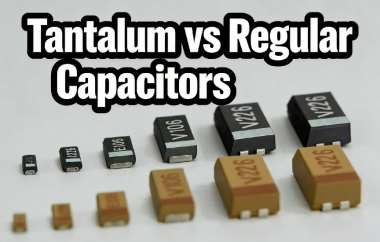
In the field of electronic components, capacitors are the most commonly used passive components and are widely applied in power filtering, signal coupling, and voltage stabilization circuits. As electronic products demand smaller sizes, higher performance, and greater stability, the use of tantalum capacitors in designs has become increasingly common. This article provides a systematic analysis from the perspectives of definitions, materials and structures, physical characteristics, electrical performance, and identification methods.
Catalog
II. Differences in Materials and Structures
III. Differences in Physical Characteristics
IV. Differences in Electrical Performance
I. Definitions
Tantalum Capacitors
A tantalum capacitor is an electrolytic capacitor based on a tantalum electrode structure. Internally, it uses a sintered tantalum metal anode to create a high surface area, on which a very thin layer of tantalum pentoxide dielectric is formed, and the cathode employs a solid or semi-solid electrolyte. Tantalum capacitors feature high capacitance, small size, stable performance, and low equivalent series resistance (ESR). They are widely used in portable electronic devices, power filtering circuits, and high-reliability applications. Their high capacitance density and stability give them a clear advantage in modern electronic product design.
Regular Capacitors
Regular capacitors refer to various types of capacitors constructed with metal electrodes and a dielectric. They include ceramic capacitors, aluminum electrolytic capacitors, polyester capacitors, and others. Different types of regular capacitors vary in materials, electrical properties, size, and application scenarios. Ceramic capacitors use a ceramic dielectric and are usually non-polarized; film capacitors use polymer films; aluminum electrolytic capacitors rely on aluminum foil and an aluminum oxide dielectric combined with a liquid or solid electrolyte. Regular capacitors come in many types and can be selected according to the intended application and performance requirements.
II. Differences in Materials and Structures
Tantalum capacitors and regular capacitors differ fundamentally in materials and internal structure:
· Materials: The electrodes in tantalum capacitors are made of tantalum, whereas regular capacitors typically use aluminum, polyester, ceramic, or similar materials.
· Structure: Tantalum capacitors are constructed with a combination of metal niobium foil and tantalum electrodes with an electrolyte. The structure of regular capacitors varies by type; for example, aluminum electrolytic capacitors use aluminum foil with an aluminum oxide dielectric, ceramic capacitors have multilayer ceramic stacks, and film capacitors consist of wound metallized films.
These material and structural differences directly affect capacitance, size, temperature tolerance, and frequency response.
III. Differences in Physical Characteristics
In terms of physical characteristics, tantalum and regular capacitors have the following main differences:
· Capacitance: Tantalum capacitors generally offer higher capacitance, ranging from hundreds to thousands of microfarads, while regular capacitors range from a few picofarads to hundreds of microfarads.
· Size: Due to the high-density tantalum material, tantalum capacitors are compact and suitable for devices with limited space. Regular capacitors are generally larger.
· Frequency Response: Tantalum capacitors perform better in high-frequency circuits, whereas regular capacitors have advantages in low-frequency circuits.
· Operating Temperature: Tantalum capacitors can operate stably between -55°C and +125°C, while the temperature range of regular capacitors depends on the material and type.
IV. Differences in Electrical Performance
The electrical performance of tantalum capacitors and regular capacitors also differs:
· Voltage Stability: Tantalum capacitors provide stable voltage output with low leakage current. Regular capacitors have slightly lower voltage stability.
· Lifespan: Tantalum capacitors typically have a long lifespan, ranging from several thousand to tens of thousands of hours. Regular capacitors vary widely in lifespan, from a few hundred hours to tens of thousands of hours, depending on type.
These performance differences make tantalum capacitors more commonly used in high-reliability and stable power filtering or coupling scenarios, while regular capacitors remain suitable for general signal processing and non-critical power applications.
V. Identification Methods
Tantalum capacitors and regular capacitors can be distinguished using the following methods:
· Markings: Most tantalum capacitors are labeled with a "T," indicating tantalum material. Regular capacitors generally do not have such markings.
· Appearance: Tantalum capacitors are often cylindrical or small SMD packages with smooth resin-coated surfaces. Regular capacitors vary in shape, including cylindrical, rectangular, or chip forms, and may include color coding.
· Capacitance Range: When the capacitance is known, higher capacitance usually indicates a tantalum capacitor, while lower capacitance may indicate a regular capacitor.
· Electrical Parameters: Checking the datasheet for rated voltage, tolerance, and other parameters can assist in identification.
It is important to note that these identification methods are not absolute. Different models and brands of capacitors may vary, so the most reliable approach is to consult the manufacturer's datasheet and manual.
VI. Conclusion
As a type of electrolytic capacitor, tantalum capacitors play a unique role in modern electronic products, especially in space-limited applications requiring high stability. Based on their materials, structures, physical characteristics, and electrical performance, they differ significantly from regular capacitors such as ceramic, film, and aluminum electrolytic types. Identifying tantalum versus regular capacitors should combine markings, physical appearance, and electrical testing to avoid misuse, which could lead to performance issues or component failure.


