
NVIDIA H200 Reportedly Halted for China Market


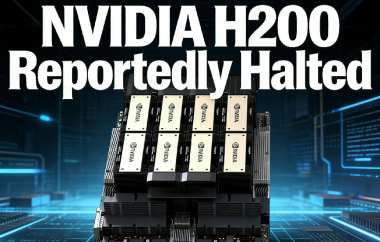
According to multiple industry reports, NVIDIA has reportedly halted production of its H200 AI accelerator that was originally intended for the Chinese market, with manufacturing capacity now being redirected to the company's upcoming Vera Rubin architecture chips.
Earlier in January, reports had already suggested that key component makers, including printed circuit board manufacturers supporting the H200 supply chain, had paused production after Chinese customers failed to place significant orders. Around the same time, U.S. officials also noted that the H200 had not yet been sold to customers in China.
Although NVIDIA previously stated it had obtained a license from the U.S. government to ship a "limited number" of H200 chips to Chinese customers, the latest supply-chain signals suggest demand has remained weak. As a result, the company has reportedly asked Taiwan Semiconductor Manufacturing Company to stop manufacturing the H200 and instead allocate wafer capacity to the newer Vera Rubin GPU generation.
This shift indicates that NVIDIA may no longer expect meaningful H200 sales in China going forward.
Policy changes have also shaped the situation. On December 8, 2025, Donald Trump announced a policy allowing NVIDIA to ship H200 AI chips to approved customers in China and other regions, with the condition that the U.S. government would receive 25% of H200 revenue from those markets.
Technically, the H200 is built on NVIDIA's Hopper architecture, the same generation behind the H20 accelerator. While Hopper is now older compared with the company’s current Blackwell architecture, the full-spec H200 still offers significantly higher capability than the export-compliant H20. Its theoretical total processing performance (TPP) can exceed the H20 by more than six times, and the chip integrates 141GB of HBM3e memory with up to 4.8TB/s of memory bandwidth, delivering a substantial improvement over the previous H100 accelerator.
Earlier expectations for the Chinese market were far more optimistic. NVIDIA had once projected that orders from China could exceed one million H200 units, and supply-chain sources even indicated additional production orders had been placed with TSMC as partners prepared for large-scale shipments.
However, the actual demand appears to have fallen short. A China-based seller of NVIDIA AI servers previously indicated that several customers had canceled their H200 orders.
Two factors are widely believed to be influencing demand. First, the H200 is based on the older Hopper architecture, which lags far behind the newer Blackwell GPUs such as B200 and B300, even though Blackwell chips remain restricted from export to China. Second, China’s domestic AI chip ecosystem has been developing rapidly, with local companies introducing increasingly competitive alternatives while government policies encourage the adoption of homegrown AI processors.
As of now, neither NVIDIA nor TSMC has publicly commented on the reports about the H200 production halt.


