
NIO's Second Shenji Chip Enters Mass Production


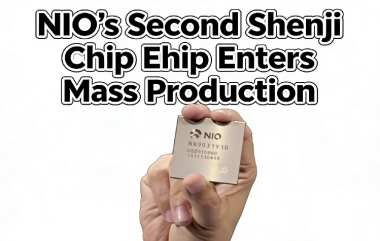
On March 10, NIO Inc. founder and CEO William Li revealed in the company's Q4 2025 and full-year earnings call that the second advanced intelligent chip from NIO's chip subsidiary has successfully completed tape-out and is now in mass production.
Beyond ongoing research and development, NIO plans to expand its chip applications into embodied robotics and other emerging fields. Li noted, "We are already seeing interest from a small number of external clients, including some automotive companies, and we've made early progress in broadening our external engagements."
In February, NIO announced that its chip subsidiary, Anhui Shenji Technology Co., Ltd., had closed its first round of equity financing, raising over RMB 2.2 billion, with a post-money valuation approaching RMB 10 billion. This financing, supported by NIO Capital and several leading industry investors, will accelerate Shenji's development and deployment of high-performance, competitive chips, supporting NIO's long-term strategy in autonomous driving and embodied intelligence. Shenji plans to release next-generation chips for intelligent driving as well as multiple chips targeting other sectors.
Anhui Shenji is China's first company to develop 5nm automotive-grade chips and achieve large-scale commercial production. Its NX9031 chip, delivering the equivalent performance of four chips in one, consistently ranks among the top in domestic automotive chip performance. Since production began in 2024, over 150,000 units have been shipped, successfully powering all NIO vehicle models.
The NX9031, NIO's first in-house intelligent driving chip officially unveiled in December 2023, uses a 5nm automotive-grade process with over 50 billion transistors, a 32-core CPU, a high-dynamic-range ISP, and a proprietary NPU for efficient AI algorithm execution. It supports ASIL-D, the highest functional safety standard, and integrates seamlessly with NIO's TianShu full-domain operating system.
Li emphasized that NIO's previous autonomous driving system relied on four Nvidia Orin X chips, delivering over 1,000 TOPS, whereas a single NX9031 achieves comparable performance to these four flagship chips. Production milestones included tape-out success in July 2024 and the global debut of the mass-produced 5nm NX9031 on the NIO ET9 in April 2025.


