
NXP Announces Chip Price Increase!



According to a newly leaked document, NXP Semiconductors issued a price adjustment notice to its partners on March 5, announcing that selected products will see price increases starting April 1, 2026.
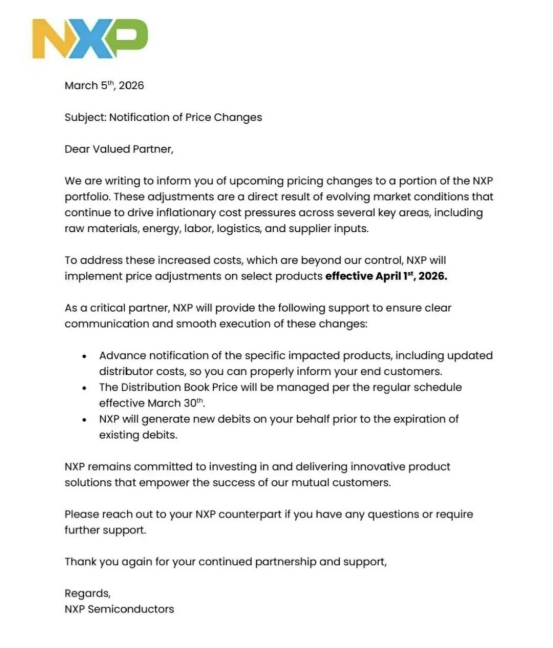
In the notice, NXP explained that the adjustment is driven by rapidly changing market conditions and rising inflation across several critical cost areas. These include raw materials, energy, labor, logistics, and supplier inputs. The company stated that these cost pressures are largely beyond its direct control, and current pricing structures are no longer sufficient to absorb the ongoing increases. As a result, price revisions will be applied to certain product lines.
Alongside the April price adjustment, NXP also confirmed that its catalog pricing will be updated on March 30 as part of the regular pricing cycle. Affected product lists and updated cost information have been shared with partners in advance so that the ecosystem can prepare for the upcoming changes.
Industry observers note that this move is not an isolated case. Instead, it reflects a broader trend across the global semiconductor sector, where supply-chain costs continue to rise. The ongoing boom in artificial intelligence applications has significantly increased demand for data-center chips such as CPUs, DRAM, and NAND, pushing manufacturing and material costs higher throughout the semiconductor value chain. In addition, recent geopolitical tensions in the Middle East have added further volatility to energy and logistics expenses.
NXP is widely recognized for its automotive and embedded processing technologies, including microcontrollers (MCUs), automotive Ethernet controllers, secure processors, and wireless connectivity solutions. Although the company has not disclosed which specific products will be affected or the exact scale of the increases, analysts believe the adjustments may focus on segments where cost pressure is most significant, such as mid-to-high-end embedded processors and automotive-grade MCUs.
Recent data from Omdia shows that the global MCU market declined slightly by 0.3% in 2025, yet demand for high-performance and automotive-grade MCUs remains strong. These chips require advanced manufacturing processes, high material precision, and stable long-term supply chains—factors that are increasingly driving up production costs. As one of the major players in automotive MCUs, NXP holds considerable pricing leverage in this segment.
At the same time, global automakers are accelerating the adoption of advanced driver-assistance systems (ADAS) and intelligent cockpit technologies, further strengthening demand for automotive semiconductors. This market momentum provides additional support for price adjustments among chipmakers.
Overall, NXP's latest pricing move highlights the growing cost pressure across the global semiconductor supply chain. In recent months, other major chip companies such as Analog Devices and Texas Instruments have also announced similar pricing changes as the industry navigates a new cycle of supply-demand shifts and rising operational costs.


