
Common-Mode vs Differential Inductor: What's the Difference?


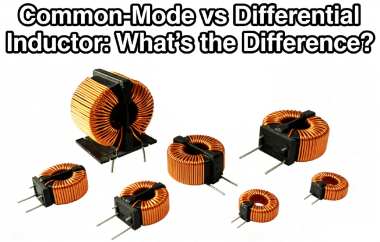
In electronic circuit design, electromagnetic interference (EMI) has always been an important factor that affects system stability and signal quality. As switching power supplies, high-speed communication interfaces, and complex electronic systems become more widely used, various types of interference signals are becoming increasingly common in circuits. Among them, common-mode interference is a type of noise signal that appears on two signal lines at the same time and can negatively affect the normal operation of devices. To solve this problem, engineers usually use a key filtering component in circuits called a common-mode inductor. A common-mode inductor can effectively suppress common-mode interference and improve a circuit's resistance to noise, so it is widely used in electronic systems such as power supplies, communications, computers, and industrial equipment.
This article will systematically introduce the definition, structural principles, key characteristics, application areas, and the differences between common-mode inductors and differential-mode inductors.
Catalog
I. What is a Common-Mode Inductor?
V. Common-Mode Inductors vs Differential-Mode Inductors
I. What is a Common-Mode Inductor?
A common-mode inductor is an inductive component used in circuits, and its main purpose is to suppress common-mode interference signals. In electronic circuits, various interference signals are often generated due to factors such as switching devices, signal coupling, and power supply noise, and these interference signals may reduce the stability of circuit operation or even affect the normal functioning of the system.
Common-mode interference is a special type of noise that usually appears simultaneously on two signal lines, with the same direction and nearly the same amplitude. This type of interference exists relative to ground and can affect electronic devices through conduction or radiation. A common-mode inductor is a filtering component specifically designed to deal with this kind of interference.
When common-mode interference signals enter a circuit, the common-mode inductor generates an induced electromotive force in its coil, which creates a reverse current that cancels or attenuates the common-mode noise. In this way, the common-mode inductor can effectively reduce the impact of interference signals on the circuit. In addition, in some circuit designs, the common-mode inductor can work together with other components to achieve differential-mode conversion, which further improves signal quality and system reliability.
II. Structure and Principle
The structure of a common-mode inductor is relatively simple and generally consists of two windings wound on the same magnetic core. These two windings usually have the same number of turns and the same winding method, and they are tightly coupled. The magnetic core is typically made from high-permeability materials, such as ferrite, to obtain higher inductance and better filtering performance.
During operation, when current flows through one of the windings, a magnetic field is generated in the magnetic core. If common-mode interference exists in the circuit, the interference will act on both windings at the same time and generate an induced electromotive force in the other winding. The current formed by this process creates a magnetic field opposite to the original magnetic field, which cancels or weakens the magnetic flux changes caused by the interference signal.
This principle, which is based on electromagnetic induction and magnetic field interaction, allows the common-mode inductor to effectively suppress common-mode noise. At the same time, because the two windings are magnetically coupled, when normal differential-mode current flows in the circuit, the magnetic fields generated by the two windings cancel each other out, so the normal signal is not significantly affected.
III. Characteristics
Common-mode inductors have several technical characteristics in electronic circuits, which make them key components in electromagnetic compatibility design.
First, a common-mode inductor has strong common-mode noise suppression capability. Through electromagnetic induction and magnetic field interaction, it can effectively reduce common-mode noise in a circuit and improve the stability and reliability of signal transmission.
Second, in some designs, a common-mode inductor can achieve differential-mode conversion. Differential-mode conversion refers to converting a common-mode signal into a differential-mode signal so that it can be filtered or suppressed more easily by the circuit. This characteristic is particularly important in communication and signal processing systems.
Third, common-mode inductors usually have relatively large inductance values. To achieve stronger noise suppression performance, they often use multilayer winding structures and high-permeability magnetic core materials to increase inductance and improve filtering performance.
In addition, common-mode inductors have certain advantages in terms of size design. By optimizing the winding structure and magnetic core materials, a higher inductance value can be achieved within a relatively small volume, which helps meet the requirements of modern electronic devices for miniaturization and high performance.
IV. Application Areas
Because common-mode inductors can effectively suppress common-mode interference signals, they are widely used in many areas of the electronics industry.
In power supply systems, common-mode inductors are often used in power input filter circuits. By suppressing common-mode noise on power lines, they can improve the stability and quality of the power output and ensure the reliable operation of the entire system.
In communication equipment, common-mode inductors are used to suppress interference signals on communication lines. By reducing noise interference, they help improve the quality and transmission stability of communication signals.
In computer systems, common-mode inductors can reduce electromagnetic interference in circuit lines and prevent system abnormalities such as crashes or data errors, thereby improving the overall stability of the device.
In the field of medical equipment, because devices require high precision and reliability, common-mode inductors are widely used to suppress electromagnetic interference and ensure the accuracy and safety of medical measurements.
In addition, in industrial automation systems, common-mode inductors are used to reduce electromagnetic noise during equipment operation and improve the stability and working accuracy of automation equipment.
V. Common-Mode Inductors vs Differential-Mode Inductors
Although both common-mode inductors and differential-mode inductors belong to the inductor family, there are clear differences between them in terms of definition, characteristics, and applications.
1. Different Definitions
A common-mode inductor refers to inductance generated when two signals pass through the same inductor coil together. A differential-mode inductor refers to inductance generated when two signals pass through two separate inductor coils, and the directions of these two coils are opposite.
2. Different Characteristics
Common-mode inductors generally have relatively small inductance values, stable frequency response, and low impedance, while differential-mode inductors usually have larger inductance values, less stable frequency response, and higher impedance.
3. Different Applications
Common-mode inductors are widely used in filter circuits, amplifier circuits, driver circuits, and voltage regulation circuits, while differential-mode inductors are commonly used in filter circuits, amplifier circuits, isolation circuits, and balancing circuits.
In practical electronic systems, engineers often use both common-mode inductors and differential-mode inductors together in order to achieve better filtering performance and suppress both types of noise at the same time.
VI. Conclusion
In summary, a common-mode inductor is an important electronic component used to suppress common-mode interference signals in circuits. It uses two windings on the same magnetic core and relies on the principles of electromagnetic induction and magnetic field interaction to present high impedance to common-mode noise, which effectively reduces the impact of interference on circuits while having minimal effect on normal differential signals. Because of its strong anti-interference capability and stable filtering performance, common-mode inductors are widely used in power systems, communication equipment, computers, medical electronics, and industrial automation. In practical electronic system design, common-mode inductors are often used together with differential-mode inductors to suppress different types of noise and improve overall electromagnetic compatibility performance.


