
Reactors vs Inductors: What's the Difference?


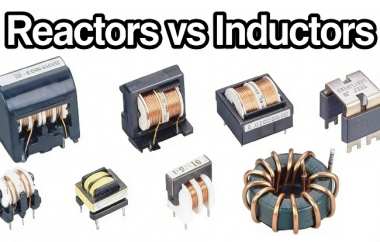
In the field of electronic components and power systems, reactors and inductors are two commonly used types of components, and they play a critical role in circuit design and power applications. Although both are related to inductive elements, electromagnetic energy storage, and AC characteristics, there are clear differences in their definitions, working principles, characteristics, and practical applications.
Catalog
III. Characteristics and Advantages
I. Definition
A reactor (Reactance) is a component used in AC circuits to change the phase relationship between current and voltage, thereby adjusting the impedance of the circuit. Reactors include both inductors and capacitors, with inductors also referred to as inductive elements. By introducing appropriate reactance into an AC system, reactors can control the current amplitude, stabilize system voltage, and achieve impedance matching and harmonic suppression in complex circuits.
An inductor (Inductor) is an energy storage component that can store and release energy in a magnetic field through self-induction. Inductors are typically made of wire wound into coils or solenoids. When current flows through them, a magnetic field is generated around the coil, enabling energy storage. Inductors are widely used in filtering, voltage stabilization, isolation, and power management circuits, making them fundamental and essential components in electronic design.
II. Working Principle
The working principle of a reactor is based on the ability of capacitors or inductors to adjust the phase of current and voltage in AC circuits. Capacitors store and release electric charges to alter the phase relationship between voltage and current, thus regulating impedance. Inductors store and release magnetic energy, similarly affecting the phase difference between current and voltage. In AC systems, reactors adjust circuit impedance in this way, enabling current control, voltage stabilization, or harmonic suppression.
The working principle of an inductor relies on Faraday’s law of electromagnetic induction. When current flows through a coil, the magnetic field generated is stored within the inductor. As the current changes, the magnetic field also changes, producing an induced electromotive force in the inductor. This induced voltage resists rapid changes in current, causing a phase difference between current and voltage. Because of this, inductors can perform filtering, current stabilization, and energy management functions in electronic circuits.
III. Characteristics and Advantages
The main characteristic of a reactor is that its impedance is directly proportional to the AC frequency; the higher the frequency, the greater the impedance. In a circuit, the impedance of capacitors and inductors can offset each other, allowing precise adjustment of the total circuit impedance. Reactors in AC systems not only control current and voltage but also improve power quality, suppress harmonics, and enhance system stability. They are important components in power systems and high-power AC equipment.
An inductor’s impedance is also positively related to frequency; as frequency increases, its ability to resist AC current becomes stronger. Inductors effectively store energy and release magnetic energy as current changes, making them crucial in filtering, isolation, and voltage stabilization circuits. Compared to reactors, inductors focus more on energy storage and optimizing electronic circuit performance. They are widely used in switching power supplies, oscillators, power filtering, and signal processing applications.
IV. Applications
Reactors are commonly used in AC circuits, where their primary functions are to regulate circuit impedance and control the phase relationship between current and voltage. For example, in power systems, reactors can be used for reactive power compensation, harmonic suppression, filters, and resonant circuits, thereby improving grid performance and power quality. In industrial distribution and high-voltage substations, reactors are essential for protecting equipment, controlling short-circuit currents, and maintaining system stability.
Inductors, on the other hand, are often used in energy storage and electronic circuits, performing filtering, isolation, voltage stabilization, and energy conversion. For instance, in switching power supplies, electronic transformers, oscillators, and communication devices, inductors store and release energy, stabilize current, and enhance circuit performance and reliability. Compared to reactors, inductors are more oriented toward electronic circuits and low-voltage power systems rather than high-power electrical systems.
V. Conclusion
In summary, although reactors and inductors are both inductive elements in principle, they differ significantly in definitions, working principles, characteristics, and application areas. A reactor is a component that changes the impedance of an AC system by adjusting the phase difference between current and voltage and includes both inductors and capacitors. An inductor, in contrast, is an energy storage component that stores and releases energy through self-induction and is used in filtering, voltage stabilization, and isolation in electronic circuits.


