
Electromagnetic Relay vs Switch: What's the Difference?


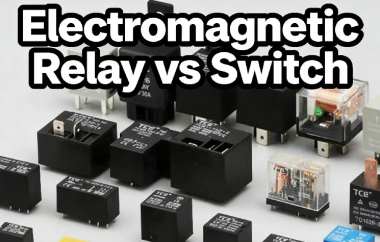
In the electronic components industry, circuit control devices are a core part of industrial automation, machinery, and power systems. Electromagnetic relays and switches, as two fundamental types of control elements, can both turn circuits on and off, but they differ significantly in working principles, application scenarios, installation methods, and lifespan. This article will provide a detailed explanation of the definition, working principle, and application scenarios of electromagnetic relays, as well as a comparison with the features and differences of switches.
Catalog
I. What is an Electromagnetic Relay?
II. How Does it Differ from a Switch?
I. What is an Electromagnetic Relay?
An electromagnetic relay is an electrical device that uses electromagnetic principles to control circuits. Its core components include an electromagnetic coil, an armature, a set of contacts, and a reset mechanism. The basic working principle of an electromagnetic relay is as follows: when a control current flows through the coil, it generates a magnetic field. The magnetic field attracts the armature to move, which drives the contacts to either close or open, thereby controlling the circuit. When the coil is de-energized, the armature returns to its original position under the action of a spring, and the contacts return to their default state.
The key feature of an electromagnetic relay is that it can use a relatively small control current to control a much larger load current, while providing electrical isolation between the control circuit and the load circuit. This characteristic makes it widely used in automation control, remote control, and high-power circuit control. Typical application scenarios include:
l Power Systems: Used for relay protection, circuit breaking control, and automated monitoring of power grids.
l Industrial Automation: Plays a critical role in production line control, starting or stopping electromechanical equipment, and signal conversion processes.
l Machinery and Industrial Production: By controlling electromagnetic relays, machinery can perform logic operations, delay control, and remote operations.
Additionally, electromagnetic relays come in a variety of types, including DC relays, AC relays, and solid-state relays, which can meet different requirements for voltage, current, and control signals.
II. How Does it Differ from a Switch?
Although electromagnetic relays and switches are both used to control the opening and closing of circuits, they differ significantly in working principles, operation methods, application scenarios, installation methods, and lifespan.
1. Working Principle
An electromagnetic relay works by energizing an electromagnetic coil, which generates a magnetic field. This magnetic field moves the armature, which drives the contacts to open or close, thus achieving automatic circuit control. In contrast, a switch relies mainly on a mechanical mechanism, such as a manual knob, push button, or toggle lever, to directly change the connection status of the circuit. In other words, a relay is an electrically controlled automatic switch, whereas a switch is a mechanically operated manual device.
2. Application Scenarios
Electromagnetic relays are suitable for situations that require remote control, automation, or logic control, such as industrial automation systems, relay protection circuits, or smart control devices. Switches, on the other hand, are more commonly used for manual operation, such as household light switches or power outlet switches.
3. Installation and Connection
Electromagnetic relays usually need to be installed in conjunction with a control system, power supply, and load, and may require configuration of a control signal input. As a result, their wiring and setup are relatively more complex. Switches are generally connected directly to the power supply and load, making installation simple and operation intuitive.
4. Lifespan and Reliability
Since relays contain mechanical components such as electromagnetic coils and contacts, their lifespan is influenced by operating frequency, load current, and environmental conditions, making them slightly shorter than that of switches. Switches have simpler structures, generally offer longer service life, and are easier to maintain.
5. Electrical Isolation
Electromagnetic relays can achieve electrical isolation between the control circuit and the load circuit, enhancing system safety and making them suitable for high-voltage or high-power applications. Ordinary switches usually do not provide isolation and can only directly connect circuits.
III. Conclusion
Although electromagnetic relays and switches are both basic elements used to control circuits, they differ clearly in terms of applicable scenarios, control methods, and system integration capabilities. Electromagnetic relays use electromagnetic principles to achieve automation and remote control, making them suitable for industrial automation, power protection, and high-power load management. Switches rely on mechanical operation and are more suitable for low-power and manual operation scenarios.


