
NXP & NVIDIA Launch Robotics Platform for Humanoids


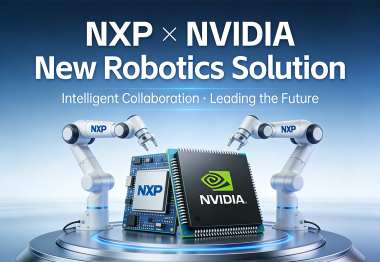
On March 17, NXP Semiconductors N.V. (NASDAQ: NXPI) announced the launch of an innovative robotics solution. The solution combines technologies from NXP and NVIDIA, supporting sensor fusion, machine vision, and precision motor control to enable reliable and secure real-time data processing and transmission, while also providing advanced networking connectivity.
According to NXP, the solution represents the first result from its foundational robotics product portfolio. Jointly developed by NXP and NVIDIA, it integrates the NVIDIA Holoscan Sensor Bridge with NXP’s highly integrated system-on-chip (SoC). This approach reduces the number of discrete components, significantly lowers power consumption and cost, and simplifies the software complexity associated with robot perception and actuation. The solution is designed for multiple robotic form factors, including humanoid robots.
Physical AI is widely regarded as the next frontier of innovation, centered on systems that can accurately, reliably, and safely perceive, understand, and interact with their environments. Humanoid robots, as a representative example of Physical AI, require low-latency, high-density sensor fusion and advanced actuation control across the entire body. NXP’s new integrated robotic body solution is designed specifically for these demands, delivering powerful edge intelligence and low-latency networking to ensure secure and reliable real-time communication.
Charles Dachs, Executive Vice President and General Manager of NXP’s Secure Connected Edge business unit, stated: “Physical AI is redefining what machines can do in the real world, and humanoid robots represent one of the most complex manifestations of this transformation. By combining NXP’s expertise in edge processing, secure networking, functional safety, and real-time control with NVIDIA’s robotics platforms, we are simplifying the development of Physical AI and enabling seamless connectivity between the edge and the central brain.”
Deepu Talla, Vice President of Robotics and Edge AI at NVIDIA, also noted: “Developing autonomous machines requires high-performance computing architectures capable of synchronizing complex motor control with real-time perception. By integrating the NVIDIA Holoscan Sensor Bridge into its edge product portfolio, NXP provides developers with a scalable foundation that accelerates the deployment of Physical AI.”
The deep collaboration between NXP and NVIDIA is helping define a unified architecture for full-body humanoid robots. NXP’s edge processors, motor control MCUs, automotive-grade networking technologies, and functional safety expertise developed through years of experience in the automotive industry are combined with NVIDIA’s AI infrastructure to create a flexible, energy-efficient system architecture for next-generation robotics.
The first solutions in NXP’s robotics portfolio to support the Holoscan Sensor Bridge include a machine vision solution based on the i.MX 95 applications processor and a motor control solution built on the i.MX RT1180 crossover MCU motion chain. These solutions integrate support for major industrial protocols such as EtherCAT® and Time-Sensitive Networking (TSN), providing a comprehensive and scalable platform for designing full-body humanoid robots.
These solutions are expected to be available in the first half of 2026.


