
Opto-Isolated vs Solid-State Relays: What's the Difference?


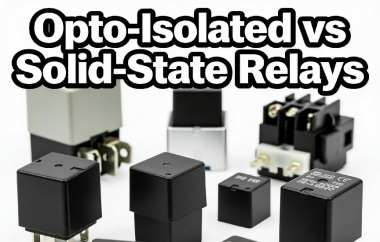
In the field of electronic components, relays are essential devices for circuit control and electrical isolation. With the advancement of semiconductor technology, solid-state relays (SSR) and opto-isolated relays (Opto MOSFET Relays) have found widespread use in industrial automation, testing systems, signal control, and power management applications. Many engineers and electronics enthusiasts often wonder: what exactly is the difference between an opto-isolated relay and a solid-state relay? This article provides a detailed analysis from the perspectives of definition, operating principle, and application characteristics.
Catalog
I. What is an Opto-Isolated Relay?
II. What is a Solid-State Relay?
III. Opto-Isolated vs Solid-State Relays
I. What is an Opto-Isolated Relay?
An opto-isolated relay is a type of solid-state relay, formally referred to in English as a Solid State Optronics Relay. Traditional relays generally rely on mechanical contacts, where current flowing through a coil generates a magnetic field that pulls the contacts to control the load. In contrast, an opto-isolated relay operates similarly to an optocoupler. The input side uses a light-emitting diode (LED) to transmit a light signal, and the photodetector on the output side receives the light and controls a MOSFET or a silicon-controlled rectifier (SCR) to switch the load on or off.
The advantages of opto-isolated relays include no mechanical contacts, fast response, long lifespan, and silent operation. They can control a variety of loads, including incandescent lamps, LEDs, heaters, and motors. The input and output are optically isolated, typically providing insulation resistance of 1000 MΩ or higher, ensuring safe separation between control signals and the load circuit. When voltage is applied to the input, the LED emits light, which triggers the photodetector to produce a voltage signal controlling the output. When the input voltage is removed, the LED stops emitting light, the photodetector voltage drops, and the output turns off, disconnecting the load.
The output of an opto-isolated relay can use either MOSFETs or SCRs. MOSFET outputs are suitable for lower-current applications, typically up to a few amperes, while SCR outputs can drive loads of tens of amperes. Compared with traditional electromechanical relays, opto-isolated relays have virtually unlimited lifespan due to the absence of contact wear, making them ideal for applications requiring high reliability.
II. What is a Solid-State Relay?
A solid-state relay (SSR) is a type of contactless switch composed of microelectronic circuits, discrete electronic devices, and power semiconductor components. The input of an SSR typically accepts a small control signal, and isolation components separate the control side from the load side. The output semiconductor devices—MOSFETs, SCRs, or TRIACs—handle the actual load current.
Compared with traditional electromechanical relays, SSRs eliminate mechanical wear, switching sparks, and electromagnetic interference, offering high reliability and long service life. They also support rapid switching and high-frequency operation, making them widely used in industrial automation, power control, heaters, and motor drive applications. Different types of SSRs are suitable for either AC or DC loads: MOSFET types are mainly for DC or low-power AC, while TRIAC and SCR types are intended for high-power AC loads.
III. Opto-Isolated vs Solid-State Relays
Although opto-isolated relays are a type of solid-state relay, there are notable differences in implementation, application focus, and performance characteristics.
First, regarding control and isolation methods, opto-isolated relays use LED and photodetector-based optical isolation, whereas SSRs may employ optical or other types of isolation. Opto-isolated relays emphasize low leakage current, low parasitic capacitance, and high insulation, making them ideal for precision instruments and signal-level circuits. SSRs have broader control capabilities, able to handle high-power AC loads as well as standard DC control.
Second, in terms of output components, opto-isolated relays mainly use MOSFETs or SCRs. MOSFETs have low on-resistance, suitable for fast switching and low-power loads, while SCRs can handle high-current AC loads. SSRs offer more diverse output options, including MOSFET, TRIAC, and SCR, allowing designers to select the best device based on load type and power requirements.
Regarding lifespan and reliability, opto-isolated relays have virtually no wear due to the absence of mechanical contacts, resulting in extremely long service life and silent operation. SSRs also provide long life, but high-current applications may require attention to heat dissipation and device voltage ratings during design.
Additionally, opto-isolated relays generally feature faster operating and reset times, making them suitable for high-precision, high-speed applications. SSR switching speed varies depending on the internal device and load characteristics, but it is still significantly faster than mechanical relays.
In summary, opto-isolated relays are best suited for precision control and low-power signal switching, while SSRs have broader applications, capable of handling both low-power precision control and high-power industrial loads.
IV. Conclusion
In conclusion, an opto-isolated relay is a specific type of solid-state relay, offering advantages such as optical isolation, fast response, and low leakage current, making it ideal for precision and signal-level applications. Solid-state relays (SSR) are a broader category, encompassing multiple semiconductor output structures and capable of supporting loads ranging from small DC circuits to high-power AC systems. Engineers should choose the relay type based on load type, control voltage, response speed, insulation requirements, and power rating to ensure system reliability and control precision.


