
What Are the Functions and Working Principles of Capacitors?


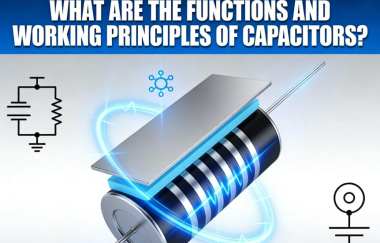
In the electronic components industry, capacitors are among the most fundamental and widely used passive components, present in nearly all electronic devices and circuit systems. From consumer electronics to industrial control equipment, capacitors play an indispensable role in signal processing, power management, and energy storage. As electronic technology continues to evolve toward higher frequency, miniaturization, and greater reliability, capacitor performance and selection have become critical considerations in engineering design.
1. What is a Capacitor
A capacitor is an electronic component capable of storing electric charge and energy. It typically consists of two conductive plates (electrodes) separated by an insulating material known as a dielectric. Depending on structure and materials, capacitors can be categorized into electrolytic capacitors, ceramic capacitors, film capacitors, mica capacitors, and others. Generally, capacitors with capacitance above 1μF are electrolytic and polarized, while those below 1μF are mostly ceramic or other non-polarized types.
2. Working Principle
The working principle of a capacitor is based on the behavior of electric charges in an electric field. When a capacitor is connected to a power supply, electrons are driven to move between the দুটি electrodes. Due to the presence of the dielectric, electrons cannot pass directly through, causing charge accumulation on the plates and forming an electric field that stores energy. This process is called charging. After the power supply is removed, the capacitor retains voltage, and the stored charge is released through the external circuit, a process known as discharging.
From a circuit perspective, capacitors allow alternating current (AC) to pass while blocking direct current (DC). Under AC conditions, the capacitor continuously charges and discharges, enabling current flow; under DC conditions, once fully charged, it behaves like an open circuit. Capacitors are also commonly used with inductors to form LC oscillation circuits for signal generation and frequency selection.
3. Characteristics and Advantages
Capacitors possess several key electrical characteristics that make them highly advantageous in electronic design. First, they have strong energy storage capability and can release energy quickly to meet transient power demands. Second, they exhibit distinct frequency response characteristics, allowing different capacitance values to target different frequency ranges, enabling effective broadband filtering when combined properly. Additionally, capacitors are compact, cost-effective, and highly reliable, making them suitable for large-scale integration.
In practical applications, capacitors also demonstrate excellent stability and tunability. Adjusting capacitance can modify circuit time constants and frequency responses. Small-value capacitors are effective for suppressing high-frequency noise, while large-value capacitors are suitable for low-frequency filtering and energy storage.
4. Main Applications
Capacitors are widely used in electronic circuits across various functions. One primary application is in power supply circuits for filtering and voltage stabilization. Large capacitors smooth rectified voltage and convert it into stable DC output. They are also used for bypassing and decoupling, where placing capacitors near power pins of integrated circuits helps suppress noise and voltage fluctuations, ensuring stable operation.
In signal processing, capacitors are used for coupling and DC blocking, allowing AC signals to pass between circuit stages while isolating DC components. In high-frequency circuits, capacitors are used in tuning and oscillation circuits, such as in radios, transmitters, and oscillators.
In energy management systems, energy storage capacitors collect and store charge, then release it rapidly when needed. These are commonly used in switching power supplies, uninterruptible power supplies (UPS), and high-power electronic systems.
5. Conclusion
In conclusion, capacitors are essential core components in the electronic components industry, serving functions such as energy storage, filtering, coupling, decoupling, and signal processing. With the advancement of modern electronics, higher performance requirements are being placed on capacitors, including lower equivalent series resistance (ESR), higher voltage ratings, and improved high-frequency performance. In the future, capacitors will play an even more critical role in fields such as new energy vehicles, 5G communications, and industrial automation, continuing to drive the progress of the electronics industry.


