
TSMC Plans 12 U.S. Fabs with $500B Investment


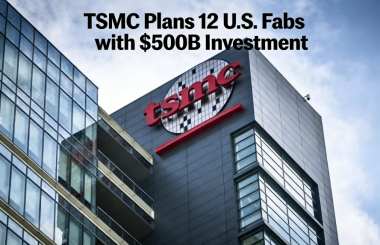
According to industry sources and multiple reports, TSMC is accelerating the expansion of its U.S. manufacturing footprint, with plans to build a large-scale “GigaFab” cluster in Arizona that could rival its production capacity in Taiwan.
The company is reportedly scaling its U.S. roadmap beyond earlier expectations, aiming to expand its Arizona operations to a total of 12 facilities, mirroring its established fab cluster model in Hsinchu. Combined investment from TSMC and Taiwanese partners in the U.S. is expected to reach approximately $500 billion, signaling a long-term strategic commitment to advanced semiconductor manufacturing.
As part of this expansion, TSMC plans to add two additional wafer fabs and two advanced packaging facilities in Arizona, bringing the total number of projects to 12. The initiative is expected to drive not only capacity relocation but also talent and supply chain migration, potentially enabling a fully localized semiconductor production ecosystem in the United States.
Despite the ambitious scale, the expansion faces structural challenges, including significantly higher construction and labor costs, as well as increased depreciation per wafer. Nevertheless, early-stage progress has not slowed, reflecting the strategic importance of the project.
Supply chain sources indicate that this 12-fab initiative represents TSMC’s largest overseas investment to date. Its role has evolved from a risk diversification strategy into a critical extension of advanced process and packaging capabilities, becoming a key pillar in the restructuring of the U.S. semiconductor manufacturing landscape.
Recent progress in tariff-related agreements between the U.S. and Taiwan has further strengthened confidence in the Arizona expansion. At the same time, the U.S. government continues to provide incentives across economic and labor frameworks to support long-term operational sustainability.
Analysts note that the scale of TSMC’s U.S. operations is likely to approach that of its Taiwan base, particularly as approximately 70% of its customers are U.S.-based fabless companies seeking greater supply chain resilience and localized production.
Driven by these factors, TSMC continues to increase capital expenditure and remains a central enabler of global AI computing infrastructure, supporting both front-end wafer fabrication and advanced back-end packaging. However, industry sources highlight that building and operating fabs in the U.S. can cost two to three times more than in Taiwan, with higher labor costs, stricter regulations, and lower construction efficiency. While conditions are gradually improving, profitability remains limited in the near term, with long-term strategic positioning taking priority.


