
Nanya Tech Q1 Revenue Surges 582.91%


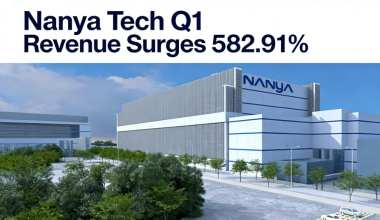
According to the latest financial update released on April 2, Nanya Technology reported strong revenue growth for March 2026, reaching NT$18.17 billion, up 560% year-on-year and 16.4% month-on-month. First-quarter revenue climbed to NT$49.09 billion, marking a record high with significant sequential and annual gains.
Company executives highlighted that the global DRAM market remains in a supply shortage, driven by sustained demand from artificial intelligence (AI) applications. As AI adoption expands from cloud infrastructure to edge devices, demand for DRAM is expected to grow steadily over the next several years. While additional capacity is projected to come online gradually, supply-demand balance may not be fully restored until late 2028.
Nanya Technology also expects DRAM pricing to rise quarter by quarter, supported by tight supply conditions. The company remains cautiously optimistic in the near term, citing continued shortages and strong demand visibility.
Strategically, Nanya is focusing on improving profitability through optimization of existing capacity, increasing the share of high-performance memory products, and expanding customized AI-related projects. The company is also accelerating construction of its new 12-inch wafer fab in New Taipei City, designed for a maximum monthly capacity of 45,000 wafers and advanced sub-10nm process technologies. Equipment installation is scheduled to begin in early 2027, with volume production expected in the second half of the year.
To support expansion, Nanya plans to significantly increase capital expenditure to NT$50 billion in 2026, up 2.7 times year-on-year, with additional capacity expected to come online by the first half of 2028. The company is also considering further fab expansion projects in Taiwan, depending on market conditions.
In addition, Nanya recently approved a private placement to raise approximately NT$78.7 billion, bringing in strategic investors including Kioxia, SanDisk, Solidigm, and Cisco. The funds will be fully allocated to advanced memory manufacturing facilities and equipment, positioning the company to capture growing demand fueled by AI-driven computing.


