
What Is the Structure of a Photoresistor?


In the modern electronic components industry, photoelectric sensing technology is widely used in smart devices, industrial control systems, and consumer electronics. Among these technologies, the photoresistor is a fundamental and critical optoelectronic component. Thanks to its simple structure, low cost, and ease of integration, it has become a popular choice for engineers and electronics enthusiasts when designing light-controlled circuits. Whether in automatic lighting systems, light-controlled switches, or photoelectric detection and automatic exposure systems, photoresistors play an essential role. Understanding their working principles and performance characteristics is crucial for optimizing circuit design and improving system stability.
What Is a Photoresistor?
A photoresistor, also known as a light-dependent resistor (LDR) or photoconductive resistor, is a non-polar resistive component made from semiconductor materials. It operates based on the internal photoelectric effect, meaning its resistance changes significantly under illumination. Typically, a photoresistor exhibits high resistance in dark conditions, while its resistance drops rapidly when exposed to light, enabling the conversion of light signals into electrical signals. Since it is essentially a resistive device, it can be used in both DC and AC circuits.
Working Principle
The core operating mechanism of a photoresistor is based on the photoconductive effect in semiconductors. When a voltage is applied across the device, a certain current flows through it. When light irradiates the sensitive material and the photon energy exceeds the bandgap of the semiconductor, electrons in the valence band absorb energy and transition to the conduction band, leaving behind holes in the valence band. This process generates electron–hole pairs. As the number of charge carriers increases, the conductivity of the semiconductor improves, and the resistance decreases significantly. The stronger the light intensity, the more carriers are generated, leading to lower resistance and higher current. When the light source is removed, the electron–hole pairs gradually recombine, and the resistance returns to its original state.
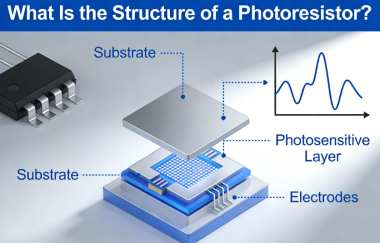
From a structural perspective, photoresistors are typically made from semiconductor materials such as cadmium sulfide or cadmium selenide. These materials are formed into a حساس layer through processes like coating, sintering, or thin-film deposition. Comb-shaped electrodes are applied at both ends to increase the effective photosensitive area and sensitivity. The device is then encapsulated in a housing with a transparent window to protect it from moisture and environmental effects. This design enables the photoresistor to respond efficiently to changes in light intensity and perform stable photoelectric conversion.
Characteristics and Advantages
Photoresistors exhibit strong sensitivity to light. Their dark resistance can reach megaohm levels, while under strong illumination, the resistance can drop to a few kiloohms or even lower. The ratio between dark resistance and light resistance can range from hundreds to thousands, indicating high sensitivity. However, their response to light intensity is generally nonlinear. Although it may appear approximately linear within a narrow range, the overall characteristic curve is nonlinear, which should be considered in precision measurement circuits.
In addition, photoresistors feature a simple structure, compact size, and low manufacturing cost, making them suitable for mass production and widespread applications. Their non-polar nature simplifies circuit design, as there is no need to consider polarity during installation. They can also operate stably over a relatively wide voltage range, making them adaptable to various application scenarios. However, their response speed is relatively slow, and their performance can be affected by temperature. Therefore, in high-precision or high-speed systems, they are often used in combination with other optoelectronic components.
In practical applications, photoresistors are widely used in light-controlled lamps, automatic dimming systems, photoelectric counters, optical tracking devices, and camera automatic exposure control circuits. With the rapid development of the Internet of Things (IoT) and smart home technologies, their application scope continues to expand.
Conclusion
Overall, the photoresistor is a classic optoelectronic component with an indispensable role in the electronics industry. Through a simple yet efficient photoelectric conversion mechanism, it converts light signals into electrical signals, providing reliable support for various automatic control and detection systems. Although it has certain limitations in response speed and linearity, its cost-effectiveness and ease of use make it a preferred choice in many electronic design solutions. For engineers involved in electronic component development, selection, and application, a deep understanding of the working principles and characteristics of photoresistors can significantly contribute to achieving more efficient and stable system designs.


