
What Are the Pros and Cons of PIN and APD Photodiodes?


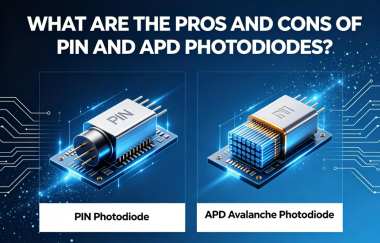
In the electronic components industry, photodiodes are one of the core devices widely used in optical signal conversion and detection applications. Among them, PIN photodiodes and APD (Avalanche Photodiodes) are the two most common types. With the rapid development of technologies such as 5G communication, data center interconnection, LiDAR, and medical imaging, higher requirements have been placed on photodetectors in terms of sensitivity, response speed, and noise performance. As a result, the application boundaries of these two devices continue to expand and show a complementary trend.
What Are PIN Photodiodes and APD Avalanche Photodiodes?
A PIN photodiode is a photoelectric conversion device composed of a P-type semiconductor, an intrinsic (I-type) layer, and an N-type semiconductor. Its key structural feature is the insertion of an intrinsic layer between the P-N junction, which improves the collection efficiency of photogenerated carriers and enhances response speed.
An APD (Avalanche Photodiode) is a high-sensitivity photodetector further optimized from the PIN structure. By operating under a high reverse bias voltage, it utilizes the avalanche multiplication effect to achieve internal current amplification, thereby significantly improving the detection capability of weak optical signals.
Working Principle
The working principle of a PIN photodiode is based on the separation of photogenerated carriers by the built-in electric field. When incident photons enter the intrinsic region, electron-hole pairs are generated and quickly separated under the electric field, forming a photocurrent. Due to the relatively thick intrinsic layer, this structure effectively improves quantum efficiency and reduces junction capacitance, thereby enhancing response speed and bandwidth performance.
The APD, on the other hand, is operated under a high reverse voltage. Carriers gain sufficient energy in the strong electric field region and undergo impact ionization with the crystal lattice, generating additional electron-hole pairs and producing a multiplication effect. This process enables internal signal gain, allowing APDs to detect extremely weak optical signals, but it also introduces additional noise and more complex operating conditions.
Advantages and Disadvantages of PIN Photodiodes
PIN photodiodes offer high response speed and wide bandwidth characteristics. The intrinsic layer significantly reduces junction capacitance, making them suitable for high-speed optical signal detection. In addition, they exhibit low noise, stable output signals, mature manufacturing processes, and relatively low cost, which makes them widely used in industrial and communication systems.
However, the main disadvantage of PIN photodiodes is the lack of an internal gain mechanism, resulting in relatively low output current. In low-light environments, they often require external amplification circuits. Furthermore, their performance is sensitive to temperature changes, requiring additional compensation in high-precision applications.
Advantages and Disadvantages of APD Avalanche Photodiodes
The most significant advantage of APD avalanche photodiodes is their internal gain capability. Through avalanche multiplication, they can significantly amplify photocurrent, resulting in extremely high sensitivity, especially suitable for weak light detection scenarios. In addition, they provide fast response speed and meet the requirements of high-speed optical communication systems, showing clear advantages in long-distance transmission systems.
However, APDs also have notable drawbacks. The avalanche multiplication process amplifies both signal and noise, increasing the overall noise level. In addition, they require high reverse bias voltage, have complex manufacturing processes, and higher costs. Their performance is also sensitive to temperature variations, often requiring temperature compensation circuits to ensure stable operation. Under high-voltage conditions, improper design may also lead to device damage.
Application Comparison Between PIN and APD Photodiodes
In optical communication systems, APD photodiodes are more suitable for long-distance fiber-optic communication systems and low-light power receiver ends due to their high gain, which effectively improves sensitivity and system performance.
In optical measurement and industrial detection, PIN photodiodes are widely used in general optical power measurement, optoelectronic switches, and short-distance communication systems due to their low cost, high reliability, and fast response characteristics.
In medical imaging applications such as PET scanning and high-sensitivity optical detection systems, APDs are preferred because their high sensitivity enables better detection of weak optical signals, improving image resolution and detection accuracy.
In remote sensing and environmental monitoring systems, PIN photodiodes are widely used due to their strong stability, simple structure, and low power consumption, making them suitable for long-term operation in applications requiring high reliability with moderate signal strength.
Conclusion
In summary, PIN photodiodes and APD avalanche photodiodes differ significantly in structural design and operating principles, which determines their suitability for different applications. PIN photodiodes, with their simple structure, low cost, and fast response speed, dominate in medium-to-low sensitivity applications. In contrast, APD avalanche photodiodes play an irreplaceable role in weak-light detection and high-speed optical communication due to their internal gain and high sensitivity. In practical system design, the selection of an appropriate photodetector should be based on factors such as sensitivity requirements, noise control, cost constraints, and operating environment.


