
What Are the Working Principles and Characteristics of a Zener Diode?


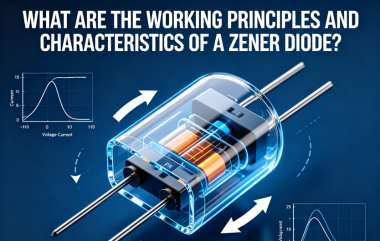
In the electronic components industry, the Zener diode is one of the most common basic semiconductor devices in electronic circuits. It is widely used in key areas such as power management, voltage reference, and overvoltage protection. With modern electronic systems continuously developing toward miniaturization and higher reliability, the Zener diode has become an indispensable component in both analog and digital circuit design due to its simple structure, low cost, and strong voltage regulation capability.
I. What Is a Zener Diode?
A Zener diode, also known as a Zener breakdown diode, is a PN junction diode specifically designed to maintain a stable voltage under reverse breakdown conditions. Unlike ordinary diodes, which are mainly used for unidirectional conduction, a Zener diode is designed to operate in a stable region when the reverse voltage reaches a specific value (known as the Zener voltage), thereby maintaining an approximately constant voltage across its terminals over a wide range of current variations.
Structurally, Zener diodes typically use a heavily doped PN junction, allowing breakdown to occur at relatively low reverse voltages. This characteristic is then utilized to achieve voltage regulation functionality.
II. Working Principle of Zener Diodes
The core operating principle of a Zener diode is based on the reverse breakdown effect, which mainly includes Zener breakdown and avalanche breakdown mechanisms. When the reverse voltage gradually increases and reaches the rated Zener voltage, the electric field within the PN junction intensifies rapidly, causing electron tunneling or impact ionization and forming a stable conductive path.
In this breakdown region, although the current may vary significantly, the voltage across the diode remains nearly constant. This is the fundamental reason why Zener diodes can achieve voltage regulation. To ensure safe operation, a series current-limiting resistor is typically used in practical circuits to prevent excessive current that could damage the device.
In addition, Zener diodes have a relatively low temperature coefficient, allowing them to maintain stable output voltage within a certain temperature range. This makes them suitable for applications requiring high voltage precision.
III. Characteristics and Advantages of Zener Diodes
Zener diodes are widely used in electronic design due to the following key characteristics and advantages:
First, they can provide stable voltage output over a wide current range, demonstrating excellent voltage regulation performance. Second, they offer good temperature stability, maintaining minimal voltage drift even under changing environmental temperatures, thereby improving system reliability.
In addition, Zener diodes are compact in size, making them suitable for high-density circuit design and easy integration into various PCB layouts. Their mature manufacturing process and low cost also make them highly cost-effective.
Zener diodes are available in a wide range of breakdown voltage ratings, allowing flexible selection based on different circuit requirements. Furthermore, they feature fast response time and low power consumption, performing well in transient voltage suppression and signal stabilization applications.
IV. Application Fields of Zener Diodes
Zener diodes are widely used in the electronics industry, mainly in the following areas:
In power supply circuits, Zener diodes are often used to provide stable reference voltages or auxiliary regulation functions, ensuring proper operation of downstream circuits. In analog circuit design, they are commonly used as precision voltage reference sources for amplifiers or ADCs.
In overvoltage protection circuits, Zener diodes can effectively suppress voltage spikes and protect sensitive electronic components from transient high voltage damage, making them widely used in communication equipment and industrial control systems.
In addition, in signal processing circuits, Zener diodes are used to limit signal amplitude and stabilize signal levels. In power management modules, they are also used for auxiliary regulation and voltage monitoring, improving overall system stability and reliability.
V. Conclusion
In summary, a Zener diode is a key semiconductor device that operates based on reverse breakdown characteristics and achieves stable voltage output through the Zener effect. It offers significant advantages such as simple structure, low cost, fast response, good temperature stability, and multiple voltage rating options.
With the continuous development of modern electronic technology, Zener diodes continue to play an important role in power regulation, voltage reference, overvoltage protection, and signal conditioning. They remain an indispensable fundamental component in electronic engineering design.


