
AI Shake-Up: TSMC Becomes World’s 7th Largest Company


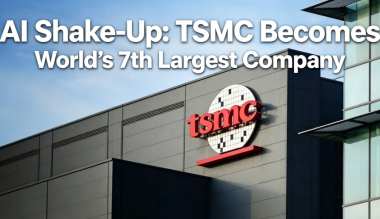
According to recent global market data and industry analysis, the artificial intelligence (AI) boom is driving a dramatic reshaping of the world’s equity landscape, with Taiwan and South Korea emerging as major beneficiaries. Powered by semiconductor leaders such as TSMC, Samsung Electronics, and SK Hynix, both markets have now surpassed several major European stock exchanges in total market capitalization.
Data compiled by Bloomberg shows that Taiwan’s stock market capitalization has reached nearly USD 4.3 trillion, overtaking the United Kingdom to become Europe’s largest market earlier this month. South Korea is also rapidly closing the gap, trailing by only around USD 140 billion. Over the past seven months, these technology-heavy markets have successively overtaken Germany and France, reflecting a broader shift in global capital toward advanced semiconductor and AI-related industries.
Taiwan is now approaching Canada in total market value, while Canadian equities have recently strengthened on gains in gold and other resource-related sectors.
Ian Samson, portfolio manager at Fidelity International, noted that the rapid rise of Korean and Taiwanese equities is being driven by a long-term structural trend in which semiconductors have become the “new oil” of the global economy. He also pointed to an accelerating wave of AI-driven investment enthusiasm, emphasizing that the semiconductor industry remains highly concentrated and oligopolistic in nature.
This week, TSMC briefly surpassed both Meta Platforms and Saudi Aramco in market capitalization, ranking as the world’s seventh-largest company at approximately USD 1.8 trillion. Meanwhile, South Korea’s leading semiconductor companies together represent around USD 1.5 trillion in market value. In comparison, Europe’s largest semiconductor equipment firm, ASML, remains significantly smaller. In fact, the combined market capitalization of all technology companies within the STOXX Europe 600 is estimated at only around USD 1.4 trillion.
Eva Lee, Head of Greater China Equities at UBS Global Wealth Management, commented that the divergence largely reflects the structural split between technology-heavy and non-technology markets. While Europe has also seen strong performance in selected AI-related stocks this year, Taiwan and South Korea benefit from a much higher concentration of technology exposure, amplifying the impact of the AI investment cycle.
Despite their outsized market valuations, the economic scale of Taiwan and South Korea remains significantly smaller than that of major European economies. According to projections from the International Monetary Fund (IMF), South Korea’s GDP is expected to reach approximately USD 1.9 trillion this year, while Taiwan’s is forecast at around USD 977 billion. Both figures remain well below the GDP levels of Germany, the United Kingdom, and France, each of which exceeds USD 3 trillion.
However, some investors have expressed concern over the high concentration risk in Asian equity indices, where a small number of semiconductor giants dominate market weighting. In South Korea’s KOSPI index, Samsung Electronics and SK Hynix together account for roughly 42% of the benchmark. Similarly, TSMC represents a comparable share of Taiwan’s stock index.
At the same time, the expanding adoption of AI technologies across industries is gradually broadening investment opportunities. As demand grows for AI-enabled hardware and applications, companies such as MediaTek and Delta Electronics have also seen rising valuations, contributing to a modest decline in TSMC’s index weighting from recent highs.
Francesco Chan, Asia and Emerging Markets Equity Strategist at JPMorgan Asset Management, noted that while Asia’s AI theme may appear concentrated at the index level, the underlying supply chain is highly diversified. He added that although leading firms continue to dominate, the ongoing expansion of AI capital expenditure is gradually distributing growth opportunities across a wider range of companies.


