
What Are the Functions and Precautions of Schottky Diodes?


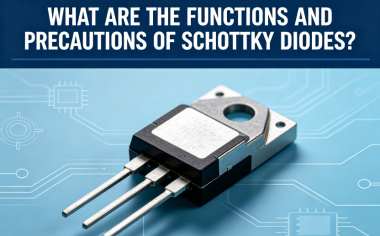
In the electronic components industry, Schottky diodes are widely used in switching power supplies, DC-DC converters, and high-frequency rectifier circuits due to their low loss and high efficiency characteristics. With the development of new energy, electric vehicles, and 5G communication equipment, the demand for high-efficiency and low-power devices continues to increase, making Schottky diodes increasingly important.
Compared with traditional PN junction diodes, Schottky diodes offer significant advantages in lower forward voltage drop and faster switching speed, making them a key fundamental component in high-performance power management systems.
I. What is a Schottky Diode?
A Schottky diode (Schottky Diode) is a unidirectional conductive device formed based on the contact between a metal and a semiconductor. Its core structure is different from that of a traditional PN junction diode. It achieves rectification through a metal-semiconductor barrier, and is therefore also known as a “Schottky barrier diode.”
Because it conducts primarily through majority carriers rather than minority carrier recombination processes, Schottky diodes naturally exhibit faster response speed and lower switching losses.
II. Functions and Characteristics of Schottky Diodes
Schottky diodes primarily perform rectification, freewheeling, and protection functions in circuits. Their key performance characteristics are as follows:
First, low forward voltage drop. The forward conduction voltage drop of Schottky diodes is typically around 0.2V to 0.4V, significantly lower than the 0.6V to 0.7V of standard silicon diodes. This provides higher energy efficiency in high-current applications and effectively reduces system power consumption.
Second, ultra-fast switching performance. Due to the absence of significant minority carrier storage effects, Schottky diodes switch extremely fast with very short reverse recovery time, making them suitable for high-frequency switching circuits and high-speed rectification applications.
Third, lower switching losses. Under high-frequency operating conditions, Schottky diodes significantly reduce reverse recovery losses, thereby improving overall power conversion efficiency.
Fourth, higher temperature sensitivity. Although they maintain a certain level of stability, their reverse leakage current increases with temperature, requiring special attention to thermal design in high-temperature environments.
III. Application Fields of Schottky Diodes
Schottky diodes are widely used in various electronic and power systems, especially in high-frequency and high-efficiency applications.
In switching power supply systems, they are commonly used in rectifier output stages and freewheeling circuits to improve conversion efficiency and reduce heat loss.
In DC-DC converters, Schottky diodes are used in synchronous rectification or auxiliary rectification circuits, helping to improve the overall efficiency of power modules.
In consumer electronics, such as mobile phone chargers and laptop power adapters, Schottky diodes are widely used to achieve miniaturization and high-efficiency designs.
In automotive electronics systems, especially in on-board power modules and new energy control systems, their fast response characteristics help improve system reliability and safety.
In addition, in RF circuits and high-speed signal detection circuits, Schottky diodes are often used for signal detection and protection applications.
IV. Precautions for Using Schottky Diodes
In practical selection and application, proper use of Schottky diodes is critical for system stability.
First, attention must be paid to the maximum reverse voltage rating. The reverse voltage capability of Schottky diodes is generally lower than that of standard diodes, so sufficient voltage margin must be ensured in power supply design to avoid breakdown damage.
Second, forward current and power dissipation must be properly controlled. Since heat is still generated during conduction, high-current applications must use effective thermal management, such as PCB copper heat dissipation or external heat sinks.
Third, special attention should be paid to reverse leakage current. At high temperatures, leakage current increases significantly, which may affect circuit stability. Therefore, careful selection is required for high-temperature applications.
Fourth, during storage and transportation, moisture, high temperature, and electrostatic environments should be avoided to ensure that device performance is not degraded.
V. Conclusion
Overall, Schottky diodes have become one of the key components in modern high-frequency power and power electronic systems due to their low forward voltage drop, fast switching capability, and high efficiency characteristics. Although they have certain limitations in terms of voltage withstand capability and high-temperature leakage current, their performance advantages can be fully utilized through proper design and selection.
With continuously improving power efficiency standards and the acceleration of high-frequency and miniaturization trends, Schottky diodes will continue to expand their applications in electronic systems and will play an increasingly important role in the future of power semiconductor devices.


