
What Are the Differences and Relationship Between Crystal Oscillators and Resonators?


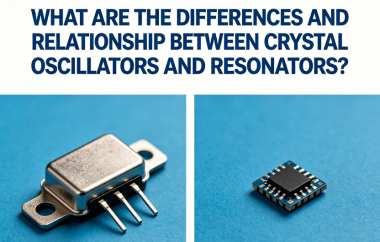
In modern electronic components industry, clock and frequency control are the core foundation of almost all electronic systems. Among them, crystal oscillators and resonators are two of the most commonly concerned key devices. Whether in communication equipment, computer systems, automotive electronics, or industrial control, they all play an important role in providing stable frequency signals. Due to their similar appearance and overlapping applications, engineers and procurement personnel often confuse them during selection. Therefore, it is essential to systematically clarify their principles and differences.
I. What are crystal oscillators and resonators?
A crystal oscillator is an electronic circuit module capable of outputting a stable frequency signal. Its core is a quartz crystal resonant structure, and it is typically composed of a crystal resonator unit, an amplifier circuit, and a feedback network. Its working principle is based on the piezoelectric effect of quartz crystals. When an electric field is applied, mechanical vibration is generated, forming a highly stable oscillation frequency, which gives it extremely high frequency accuracy and strong anti-interference capability.
In contrast, a resonator generally refers to a basic component that uses inductance (L) and capacitance (C), or the resonant characteristics of a crystal itself, to produce energy exchange and resonance at a specific frequency point. It usually does not have a complete oscillation capability on its own and requires external circuitry to generate a stable output signal. Therefore, it is more often used as a frequency selection or filtering fundamental unit.
II. Differences and relationships between crystal oscillators and resonators
From the perspective of working principles, crystal oscillators rely on the piezoelectric effect of crystals combined with feedback amplification circuits to form a closed-loop oscillation system, while resonators mainly rely on LC networks or the passive resonant characteristics of crystals for frequency selection. Essentially, one is an “active oscillation system,” and the other is a “passive resonant unit.”
From the perspective of frequency stability, crystal oscillators include internal temperature compensation and signal shaping circuits, giving them higher frequency stability and stronger resistance to environmental interference, making them suitable for high-precision clock applications. Resonators, on the other hand, have relatively lower frequency stability and are more easily affected by temperature, voltage fluctuations, and load variations.
From the perspective of output capability, crystal oscillators can directly output standard square-wave or sine-wave clock signals, while resonators themselves do not have driving capability and require external oscillator circuits to produce valid output signals. Therefore, they are usually located at the front-end or basic frequency selection stage in system architecture.
From the perspective of application fields, crystal oscillators are widely used in communication base stations, CPU clocks, GPS modules, and high-precision timing equipment. Resonators are more commonly used in RF circuits, filtering networks, and frequency selection modules in wireless communication systems.
From the perspective of their relationship, crystal oscillators are essentially complete oscillation systems built on the basis of crystal resonators. They can be regarded as an engineering extension and enhancement of resonators. At the same time, in some circuit designs, resonators can also serve as peripheral frequency selection or filtering components for crystal oscillators.
III. Conclusion
In summary, although crystal oscillators and resonators are both closely related to frequency selection and oscillation, they play very different roles in electronic systems. Crystal oscillators are high-stability, high-precision active clock sources, while resonators are basic passive frequency-selective components. In practical electronic design and component selection, appropriate choices should be made according to system requirements for frequency accuracy, stability, and power consumption, ensuring overall circuit performance remains stable and reliable.


