
What Are the Functions and Characteristics of Thyristors?


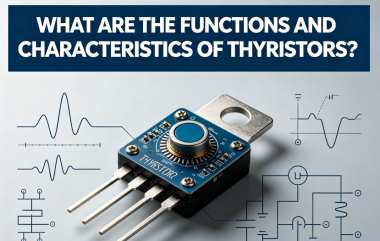
In modern power electronics and industrial control systems, the thyristor (SCR, Silicon Controlled Rectifier) is a widely used high-power semiconductor device. It is widely applied in rectification, motor control, power regulation, and industrial heating due to its excellent current handling capability and stable switching characteristics. With the development of industrial automation and new energy technologies, the importance of thyristors in high-power electrical energy control continues to increase, making them an indispensable fundamental component in power electronic systems.
I. What is a Thyristor?
A thyristor is a semiconductor device with controllable conduction characteristics, typically composed of a PNPN four-layer semiconductor structure and featuring three terminals: anode, cathode, and gate. Its core feature is “controlled conduction”: when a trigger current is applied to the gate, the thyristor switches from a blocking state to a conducting state. Even after the trigger signal is removed, as long as the main circuit current remains above the holding current, it continues to conduct. This unique “latching” characteristic gives thyristors extremely high control efficiency and stability in high-power circuits.
II. Functions of the Thyristor
The role of thyristors in power electronic systems is mainly reflected in the precise control of voltage, current, and power, with applications covering several key scenarios.
In AC/DC conversion, thyristors are commonly used in controlled rectifier circuits to efficiently convert alternating current (AC) into direct current (DC), while adjusting the output voltage by controlling the conduction angle.
In motor control applications, thyristors are used in DC motor speed regulation and AC motor soft-start systems, enabling smooth control of speed and torque by adjusting conduction time.
In power management systems, thyristors act as high-power switching devices, enabling power on/off control and optimized power distribution, thereby improving overall energy efficiency.
In industrial lighting and dimming systems, thyristors use phase control technology to regulate voltage waveforms, achieving precise control of light brightness.
In industrial heating and temperature control systems, thyristors regulate the power output of heating elements to achieve stable temperature control, widely used in electric furnaces and heat treatment equipment.
In addition, in power quality improvement and regenerative energy recovery systems, thyristors are used to suppress harmonics, improve power factor, and recover braking energy, thereby enhancing energy efficiency.
III. Characteristics of Thyristors
The widespread use of thyristors in industrial and power systems is mainly due to their unique electrical performance and structural advantages.
First, thyristors have extremely high power handling capability and can withstand large currents and high voltages, making them suitable for industrial high-power applications.
Second, their triggering control is simple, requiring only a small gate current to turn on, which reduces the complexity of the driving circuit.
Third, thyristors have unidirectional conductivity, allowing current to flow only from anode to cathode, giving them a natural advantage in rectifier circuits.
Fourth, the latching characteristic is one of their most important features: once turned on, they remain conducting even after the control signal disappears, improving system stability.
At the same time, thyristors offer high conduction efficiency, low on-state voltage drop, and reduced power loss, which is beneficial for efficient power conversion.
In terms of thermal stability, thyristors can operate reliably in high-temperature environments and adapt to complex industrial conditions.
In addition, their relatively simple structure and low manufacturing cost provide excellent cost-effectiveness. They also support parallel operation to increase power capacity and meet higher-power application requirements.
IV. Conclusion
Overall, the thyristor, as an important power semiconductor device in the field of power electronics, plays a crucial role in industrial control, motor drives, power conversion, and energy management due to its high power handling capability, reliable triggering mechanism, and excellent stability. With the continuous advancement of power electronics technology toward higher efficiency and intelligence, thyristors will continue to maintain an irreplaceable position in medium- and high-power applications and further drive the development of industrial power control technologies.


