
How to Determine Whether a Thyristor (SCR) Is Good or Faulty?


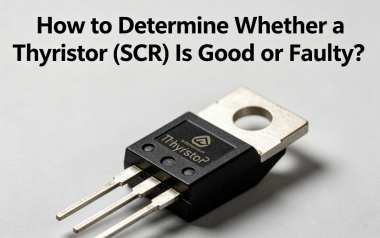
In the electronic components industry, the thyristor (SCR, Silicon Controlled Rectifier) is a widely used semiconductor power device in the fields of power electronics and industrial control. It plays an irreplaceable role in rectification, voltage regulation, motor speed control, and power supply control systems. With the development of industrial automation and new energy equipment, the stability and reliability of thyristors in high-voltage and high-current applications have become increasingly important. Therefore, a correct understanding of its working principle, performance characteristics, and methods for quickly determining its quality is of great significance for electronic engineers and maintenance technicians.
I. What is a Thyristor?
A thyristor is a power switching device with a four-layer semiconductor structure (PNPN), typically consisting of three terminals: anode (A), cathode (K), and gate (G). Essentially, it is a controllable rectifier device. When not triggered, even if a forward voltage is applied between the anode and cathode, it will not conduct. It only switches from the off state to the on state when a trigger signal is applied to the gate, and it will continue conducting until the current drops below the holding current.
This characteristic makes the thyristor widely used in AC voltage regulation, DC motor control, electric welding power supplies, and industrial heating systems. It is a typical “controllable switch-type power device.”
II. Working Principle of the Thyristor
The working principle of a thyristor is based on a dual-transistor equivalent model formed by its PNPN structure. When a forward voltage is applied between the anode and cathode, the device remains in a blocking state, with only a small leakage current flowing.
When an appropriate trigger current is applied to the gate (G terminal), an internal positive feedback process is formed within the PN structure, causing the thyristor to quickly switch into the conducting state. Once turned on, even if the gate signal is removed, the device remains conducting until the main circuit current drops below the holding current (for example, at the AC zero-crossing point), at which time the thyristor turns off automatically.
This “trigger-on, latch-on” behavior enables high efficiency and stability in phase control and power regulation applications.
III. Main Characteristics of the Thyristor
The widespread use of thyristors in industrial circuits is mainly due to the following notable characteristics:
First, strong power handling capability. Thyristors can withstand high reverse voltage and large forward current, making them suitable for high-voltage and high-power circuits such as motor drives and power rectification systems.
Second, simple control method. A small trigger current applied to the gate terminal is sufficient to control a large current, achieving a small-control-large power switching effect.
Third, low conduction loss. In the conducting state, the voltage drop across the thyristor is relatively low, resulting in low overall power loss, making it suitable for long-term industrial operation.
Fourth, high stability. Thyristors have a mature structure and can maintain good reliability under high temperature and high load conditions, making them suitable for industrial-grade applications.
Fifth, moderate switching speed. Although thyristors are not high-speed switching devices, their switching performance is fully sufficient for power frequency and medium-to-low frequency control applications.
IV. How to Determine Whether a Thyristor is Good or Faulty
In electronic repair and equipment testing, a multimeter can be used for preliminary judgment of a thyristor by checking whether its conduction and blocking characteristics are normal.
First, set the multimeter to resistance mode (recommended 200Ω or the lowest range) and ensure the probes are working properly. The display should show “OL” or infinite resistance, indicating that no conduction path is formed.
Next, perform a conduction test. Connect the red probe to the anode (A) and the black probe to the cathode (K). At this point, the thyristor should remain in the off state, and the multimeter should still show a high resistance value or “OL”.
Then perform a gate triggering test. Use a wire to briefly connect the anode and gate (G), or inject a small triggering current into the gate. If the thyristor is normal, it will switch to the conducting state, and the multimeter reading will drop significantly to a low resistance value, indicating successful triggering.
Next, check the holding conduction capability. After removing the gate trigger, if the anode and cathode still remain in a conducting state (low resistance), it indicates that the device has normal latching performance. If conduction disappears immediately, it may indicate internal damage or parameter failure.
Finally, perform a reverse blocking test by reversing the probes (cathode to anode). Normally, the display should show “OL” or a very high resistance value. If obvious conduction or abnormally low resistance appears, it indicates that the thyristor has been breakdown-damaged.
Through these steps, the operating condition of a thyristor can be accurately evaluated.
V. Conclusion
As a core power device in power electronics systems, the thyristor plays an important role in industrial control and energy conversion applications. Its “controllable turn-on and latching conduction” mechanism gives it a significant advantage in high-power regulation. By understanding its basic principles, structural characteristics, and multimeter testing methods, engineers can effectively evaluate thyristor quality, thereby ensuring the stable operation and long-term reliability of electronic and electrical equipment.


