
What Are the Main Characteristics of Photoelectric Switches?


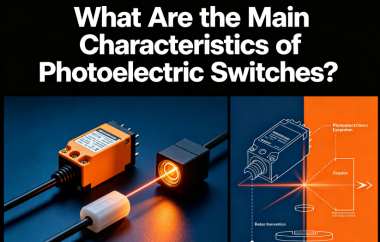
In the electronics components industry, photoelectric switches, as a key electronic component in modern industrial automation and intelligent detection systems, are widely used in industrial control, logistics sorting, automated production lines, and safety protection systems due to their non-contact detection, high reliability, and fast response characteristics. With the development of intelligent manufacturing and Industry 4.0, the demand for photoelectric switches in high-precision detection and high-speed response scenarios continues to grow, making them an important part of the electronic sensing field.
I. What is a Photoelectric Switch?
A photoelectric switch is a sensor device that uses the photoelectric effect to detect objects. Its core consists of a light-emitting device (usually an infrared LED) and a photoelectric receiving device (such as a photodiode, phototransistor, or photoresistor). When a detected object enters the sensing area, it changes the light propagation path (blocking, reflecting, or scattering), thereby causing a change in the optical signal at the receiving end. This is then converted into an electrical signal output to achieve switching control functions.
At the electronic device level, the performance of photoelectric devices can be characterized by their optical illumination characteristics, which reflect the relationship between input optical power and output photocurrent. Responsivity R is commonly used to describe device sensitivity. For photoconductive devices, the ratio of output current I to input optical power P is called current responsivity Ri; for photovoltaic devices, the ratio of output voltage U to input optical power P is called voltage responsivity Ru. These parameters directly affect the detection accuracy and application range of photoelectric switches.
II. Working Principle of Photoelectric Switches
The working principle of photoelectric switches is based on the photoelectric conversion process. The emitter continuously or modulates optical signals. When the light beam propagates within the detection area, the receiver continuously monitors changes in light intensity. When an object enters the optical path, the optical signal undergoes changes such as blocking, reflection, or scattering, causing changes in the output current or voltage of the photoelectric device, thereby triggering the downstream circuit to perform switching actions.
From the perspective of photoelectric devices, their spectral characteristics determine the device’s response capability to different wavelengths of light, namely the relationship between relative sensitivity K and incident wavelength λ, also known as spectral response. Different materials have different peak response wavelengths. Therefore, in the design of photoelectric switches, it is necessary to properly match the light source and the photoelectric device to improve overall system sensitivity. For example, when the measured object itself acts as a light source, the photoelectric receiving device should be selected according to its radiation wavelength to ensure optimal detection performance.
At the same time, the response time of photoelectric devices directly affects the dynamic performance of photoelectric switches. A shorter response time indicates better dynamic performance. In modulated light applications, the upper limit of modulation frequency is constrained by response time. Generally, the response time of photoresistors is about 0.1~0.00001s, phototransistors about 0.00002s, and photodiodes have even faster response speeds, about one order of magnitude faster than phototransistors, making them more suitable for high-speed detection scenarios.
III. Main Characteristics of Photoelectric Switches
As a non-contact electronic detection device, photoelectric switches offer multiple technical advantages. First, their detection method does not rely on mechanical contact, avoiding wear and tear associated with traditional mechanical switches and significantly improving service life and stability. Second, they have fast response speeds, meeting the real-time detection requirements of high-speed production lines.
In terms of device performance, the sensitivity and noise characteristics of photoelectric switches are closely related. Peak detectivity originated from infrared detector technology and is used to measure the output signal generated in the absence of light due to intrinsic shot noise and thermal noise at the input of the preamplifier. This is characterized using noise equivalent power P. This parameter is particularly important for low-light detection systems, as it directly affects the detection limit and anti-interference capability of the system.
In addition, temperature has a significant impact on the performance of photoelectric devices. It not only changes sensitivity but also affects spectral response characteristics. As temperature increases, the spectral response peak typically shifts toward shorter wavelengths. Therefore, in high-precision detection systems, temperature compensation or constant-temperature operation is often required to ensure detection stability.
In terms of electrical characteristics, the volt-ampere characteristics of photoelectric devices are an important basis for the design of photoelectric switches. Under a given illumination condition, the relationship between terminal voltage and photocurrent determines the operating state of the output circuit. In practical applications, it is necessary to ensure that the device operates within the allowable power range to avoid performance degradation or device damage.
Overall, photoelectric switches not only feature high sensitivity, high reliability, and fast response, but their performance is also influenced by multiple parameters such as spectral characteristics, response time, noise level, and temperature. Therefore, systematic matching and optimization are required during design and selection.
IV. Conclusion
Photoelectric switches, as an important type of sensor in the electronic components industry, integrate photoelectric effect and electronic signal conversion technology, playing an irreplaceable role in industrial automation and intelligent detection fields. With continuous advancements in photoelectric device technology, their sensitivity, response speed, and environmental adaptability are continuously improving, leading to expanding application scenarios. In the future, with the increasing demand for high-precision manufacturing and intelligent systems, photoelectric switches will achieve higher performance and greater reliability across a broader range of industrial applications.


