
What Is the Proper Way to Use an Optocoupler Relay?


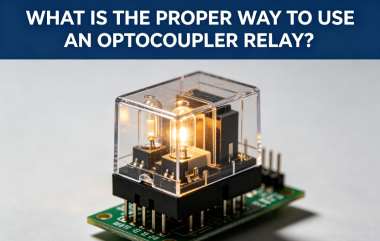
In the electronics components industry, the optocoupler relay is a commonly used electrical isolation and control device. It is widely applied in automation control, power management, and communication equipment. It achieves electrical isolation between input and output through optical signals, effectively preventing interference from high-voltage circuits on low-voltage systems, thereby improving overall system safety and reliability. As electronic devices continue to develop toward miniaturization and higher speed, the importance of optocoupler relays is also increasing.
I. What is an Optocoupler Relay?
An optocoupler relay is an electronic device that uses the principle of optoelectronic coupling to achieve electrical isolation and signal control. It typically consists of a light-emitting diode (LED) and a light-sensitive transistor or photodiode as the receiving element. When the input terminal is powered, the LED emits light, and the optical signal is detected by the receiving side and converted into an electrical signal, thereby turning the circuit on or off. Unlike traditional electromagnetic relays, optocoupler relays have no mechanical contacts, which gives them higher reliability and longer service life.
II. Working Principle of Optocoupler Relays
The core working principle of an optocoupler relay is the “electrical–optical–electrical” conversion process.
When voltage is applied to the input terminal, a current-limiting resistor controls the current flowing into the light-emitting diode (LED). Under forward bias conditions, the LED begins to emit light, producing infrared or visible optical signals.
These optical signals are received by a built-in phototransistor inside the same device. When the phototransistor receives light, the number of internal charge carriers increases, causing the path between the collector and emitter to conduct, forming an output current path and achieving a “switch-on” state.
When the input signal disappears, the LED stops emitting light. Without optical excitation, the phototransistor returns to its cutoff state, and the output returns to an open circuit condition.
Through this process, complete electrical isolation between input and output is achieved, with information transmitted only through light, effectively preventing high-voltage impact on low-voltage circuits.
III. Advantages and Usage Methods of Optocoupler Relays
Optocoupler relays offer several advantages in electronic systems. First, they provide excellent electrical isolation, effectively preventing interference from high-voltage circuits and improving system safety. Second, they have relatively fast response speeds, making them suitable for high-speed switching applications. In addition, due to the absence of mechanical structures, optocoupler relays have a long service life and strong vibration resistance, making them suitable for complex industrial environments.
In terms of usage, an appropriate model should first be selected based on the actual application, with attention to parameters such as input current, output voltage, and load capacity to ensure safe operation within specified limits. Secondly, during circuit connection, the input terminal should be connected to the control signal source, while the output terminal should be connected to the load circuit, such as PLC interfaces, motor driver modules, or switching control circuits.
When driving the input terminal, a stable voltage or current signal should be provided to avoid fluctuations that may affect switching performance. During actual operation, the output load condition should be regularly checked to ensure accurate and reliable signal transmission.
In addition, proper wiring practices must be followed. Input and output lines should be strictly separated to reduce electromagnetic interference. It is also important to avoid using the device in humid or high-static environments to prevent performance degradation and reduced lifespan.
IV. Application Areas of Optocoupler Relays
Due to their excellent isolation performance and stability, optocoupler relays are widely used in various fields. In industrial automation control systems, they are commonly used in PLC input/output isolation modules to ensure safe connection between control signals and actuators.
In power management systems, optocoupler relays are used in switching power supply feedback loops to achieve signal transmission and isolation between high-voltage and low-voltage sides, improving power stability. In smart home appliances, they are used to control high-power loads such as motors and heating elements.
In addition, they also play an important role in communication equipment, medical electronic instruments, and new energy vehicle electronic systems, where they enhance anti-interference capability and system safety.
V. Conclusion
Overall, the optocoupler relay is a key electronic component that achieves electrical isolation and control through optical signals. It not only offers fast response, strong anti-interference capability, and long service life, but also significantly improves the safety and stability of electronic systems. With the continuous development of modern industrial control and intelligent electronic devices, the application scope of optocoupler relays continues to expand. Proper selection and correct usage of optocoupler relays will help build more reliable and efficient electronic control systems.


