
What Are the Advantages and Applications of Schottky Diodes?


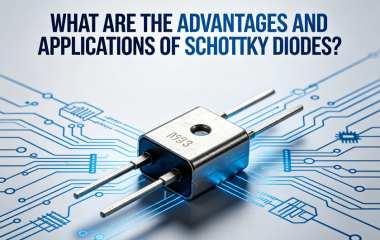
In the electronic components industry, diodes, as one of the fundamental semiconductor devices, play essential roles in rectification, freewheeling, protection, and signal modulation. Among them, the Schottky diode has gained significant importance in power management and high-frequency circuits due to its low forward voltage drop and fast switching characteristics. As electronic devices continue to evolve toward higher efficiency, lower power consumption, and higher operating frequencies, the application value of Schottky diodes keeps increasing. They have become indispensable components in switch-mode power supplies, power adapters, and communication equipment.
The Schottky diode is a metal-semiconductor contact device, and its structure is fundamentally different from that of traditional PN junction diodes. This structural difference gives it unique advantages in conduction characteristics and dynamic response, making it widely used in high-performance electronic systems.
I. What Is a Schottky Diode?
A Schottky diode is a rectifying device formed by a metal-to-N-type semiconductor junction that creates a Schottky barrier. Common metals used include gold, silver, aluminum, and platinum. In industrial applications, aluminum-silicon structures are more commonly used to reduce costs and improve process consistency.
Its operating principle is based on the barrier formed at the metal-semiconductor interface. When a forward voltage is applied, electrons in the N-type semiconductor diffuse from the semiconductor side to the metal due to concentration differences, generating current. Under reverse bias, the barrier is strengthened, effectively blocking current flow and enabling unidirectional conduction.
Unlike PN junction diodes, Schottky diodes do not rely on minority carrier storage effects, and therefore do not exhibit significant reverse recovery behavior. This is the fundamental reason for their high-speed switching capability.
II. Core Advantages of Schottky Diodes
The widespread use of Schottky diodes in electronic circuits is mainly attributed to the following key performance advantages:
First is the low forward voltage drop. Conventional silicon diodes typically have a forward voltage drop above 0.7V, whereas Schottky diodes usually range from 0.15V to 0.45V. This significant reduction in voltage drop effectively reduces power loss and improves overall power conversion efficiency, making them especially suitable for low-voltage and high-current applications.
Second is extremely fast switching speed. Since Schottky diodes are majority carrier devices and do not involve minority carrier storage, their reverse recovery time is extremely short and mainly determined by the charging and discharging of junction capacitance. This allows stable operation in high-frequency switching circuits, making them suitable for switch-mode power supplies and high-frequency rectification systems.
Third is lower switching loss. During high-frequency switching, Schottky diodes exhibit extremely low reverse recovery charge, significantly reducing energy losses and improving system efficiency. This is particularly important in high-frequency DC-DC converters.
Fourth is low noise characteristics. Compared with conventional PN junction diodes, Schottky diodes generate less unwanted noise during operation, which helps improve signal integrity in communication and RF circuits.
Fifth is high current density capability. Due to their thin depletion region, a relatively small voltage is sufficient to achieve large current conduction, making them suitable for high-current rectification and power output stages.
Overall, Schottky diodes offer irreplaceable advantages in low-voltage, high-frequency, and high-efficiency electronic systems.
III. Typical Application Areas of Schottky Diodes
Thanks to their excellent electrical performance, Schottky diodes are widely used in various electronic and power systems and play a critical role in modern electronic products.
In power management systems, Schottky diodes are widely used in computer power supplies, laptop adapters, LCD display power supplies, and electric vehicle chargers. Their low forward voltage drop significantly improves power conversion efficiency, reduces heat dissipation, and enhances system stability.
In switch-mode power supplies (SMPS), Schottky diodes are commonly used as output rectifiers. Their fast switching capability allows them to operate efficiently in high-frequency environments, improving power density and reducing energy loss.
In automotive electronics, Schottky diodes are used in vehicle power management systems, electronic control unit (ECU) protection circuits, and headlight driving systems. Their fast response helps improve the reliability and safety of automotive electronic systems.
In communication and signal processing circuits, Schottky diodes are used for signal rectification, detection, and protection. Their low noise and high-frequency response make them suitable for RF front-end and high-speed data processing systems.
In addition, in high-speed digital circuits, Schottky diodes are often used as clamping devices or logic level shifters to protect sensitive chips from overvoltage damage.
IV. Conclusion
Overall, Schottky diodes hold an important position in the modern electronics industry due to their low forward voltage drop, fast switching performance, low losses, and excellent high-frequency capability. As electronic devices continue to evolve toward higher efficiency, smaller size, and higher operating frequencies, their range of applications continues to expand.
In the future, Schottky diodes will continue to play a key role in emerging fields such as renewable energy, electric vehicles, 5G communications, and high-efficiency power conversion systems, maintaining their importance in the electronic components industry chain.


