
What Is the Difference Between High-Frequency Inductors and Supercapacitors?


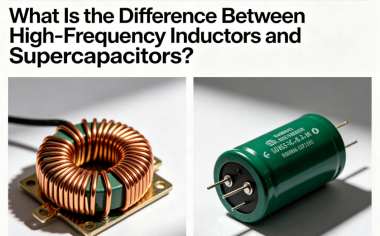
In the electronic components industry, high-frequency inductors and supercapacitors are two key electronic components that play an irreplaceable role in communications, power management, and new energy applications. With the widespread adoption of 5G communications, the Internet of Things (IoT), electric vehicles, and renewable energy systems, the market attention on these two types of components continues to grow. Although both are related to “energy,” they differ fundamentally in working principles, functional positioning, and application scenarios. Understanding their differences helps engineers optimize design selection and system performance.
I. What Are High-Frequency Inductors and Supercapacitors?
A high-frequency inductor is an inductive component specifically designed for high-frequency circuits. Its core function is to store and release magnetic field energy in alternating current (AC) signals through electromagnetic induction. It is commonly used in radio frequency (RF) circuits, filtering, and impedance matching networks. Its design focus is on high self-resonant frequency, low loss, and stable performance at high frequencies.
A supercapacitor is a new type of energy storage device between traditional capacitors and batteries. It stores electrical energy mainly through the electric double-layer structure formed at the interface between electrodes and electrolyte. It features high power density and fast charge-discharge capability and is widely used in energy storage systems that require instantaneous high power output.
II. Characteristics and Applications of High-Frequency Inductors and Supercapacitors
The main characteristics of high-frequency inductors include miniaturized design, high self-resonant frequency, low DC resistance (DCR), and low parasitic capacitance. These features enable stable performance in high-frequency environments while reducing signal loss and energy waste. In terms of applications, high-frequency inductors are widely used in smartphones, wireless communication devices, Bluetooth modules, automotive radar systems, and medical electronic equipment for signal processing and filtering circuits. They are fundamental components in high-frequency circuit design.
The core advantages of supercapacitors include high power density, ultra-long cycle life, high safety, and strong environmental adaptability. They can achieve charge and discharge within seconds and support hundreds of thousands to millions of cycles. In applications, supercapacitors are commonly used in electric vehicle start-stop systems and regenerative braking energy recovery, smoothing power fluctuations in renewable energy systems, grid frequency regulation, and fast power supply solutions for portable electronic devices. They play an important role in energy management systems.
III. Differences Between High-Frequency Inductors and Supercapacitors
In terms of working principle, high-frequency inductors rely on electromagnetic induction, where coils generate a magnetic field to temporarily store energy and suppress current changes. Supercapacitors, on the other hand, store energy through physical adsorption of charges at the electrode-electrolyte interface, forming an electrostatic field.
Regarding energy storage mechanisms, high-frequency inductors are mainly used to control current variations, with limited energy storage capacity and release behavior dependent on circuit configuration. Supercapacitors can store relatively large amounts of electrical energy and release it quickly, making them suitable for applications requiring instantaneous high power.
In terms of application fields, high-frequency inductors are more focused on high-frequency signal processing, electromagnetic compatibility, and RF circuit design. Supercapacitors are more commonly used in energy storage and power compensation, such as electric vehicle starting, energy recovery, and power system regulation.
Regarding frequency characteristics, high-frequency inductors are designed for high-frequency environments, and their parameters vary significantly with frequency. Supercapacitors primarily operate in DC or low-frequency conditions and have relatively poor high-frequency performance.
In terms of physical structure, high-frequency inductors are small in size and easy to integrate, while supercapacitors require a larger electrode surface area for energy storage, resulting in a generally larger form factor.
In environmental adaptability, high-frequency inductors are relatively sensitive to temperature and humidity, whereas supercapacitors offer better wide-temperature stability and reliability.
In terms of cost and lifespan, high-frequency inductors are relatively low-cost but may require replacement in complex environments. Supercapacitors are more expensive but offer extremely long service life and lower maintenance requirements.
IV. Conclusion
Although high-frequency inductors and supercapacitors both belong to the field of electronic components, they serve completely different functional roles. One focuses on high-frequency signal processing and electromagnetic optimization, while the other is dedicated to efficient energy storage and instantaneous power output. In practical electronic system design, component selection should be based on application requirements to achieve an optimal balance of performance, cost, and reliability. With the continuous development of electronic technology and the new energy industry, both will continue to play important roles in their respective fields and drive electronic systems toward higher efficiency and greater integration.


