
Core or Air-Core Reactors: What Are the Pros and Cons?


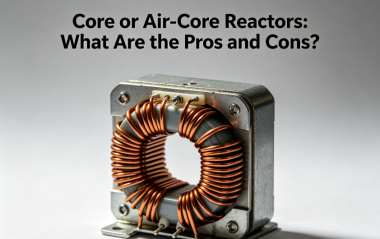
With the rapid development of power electronics technology, devices such as frequency converters, rectifiers, inverters, UPS power supplies, new energy generation equipment, and various industrial automation systems have been widely applied. However, these devices are mostly nonlinear loads. During operation, they generate a large amount of harmonic current and reactive power, which causes waveform distortion of grid voltage and current, thereby affecting power quality and system stability.
To suppress harmonics, limit short-circuit current, improve power factor, and enhance the safety of power system operation, reactors have become an indispensable component in modern power systems. Whether in industrial distribution systems, new energy generation fields, railway transportation, motor control, or power compensation systems, reactors play a critical role. Understanding the structural characteristics of reactors and the advantages and disadvantages of different structural types is of great significance for equipment selection and system design.
I. What Is a Reactor?
A reactor is an electrical device that uses the inductive effect of a coil to limit the change of alternating current. Essentially, it is an inductive component. When current passes through the reactor winding, a magnetic field is generated around it, producing inductive reactance that resists changes in current.
Depending on application requirements, reactors can be used to limit short-circuit current, absorb reactive power, filter harmonics, stabilize system voltage, and protect electrical equipment. According to function, reactors can be classified into series reactors, current-limiting reactors, filter reactors, starting reactors, smoothing reactors, and shunt reactors. According to structural form, they are mainly divided into air-core reactors and iron-core reactors.
II. Structural Characteristics of Reactors
The performance of a reactor depends not only on design parameters but also on its structural form and manufacturing process. Modern reactors typically have the following structural characteristics:
First, iron-core reactors are generally made of high-quality cold-rolled silicon steel laminations. Multiple uniform air gaps are set within the core to control magnetic circuit characteristics. These air gaps are insulated with high-strength insulating materials and fixed with high-temperature-resistant adhesive, ensuring that the gap size remains stable during long-term operation, thereby guaranteeing accurate reactance values and reliable performance.
Second, the end faces of the iron core are usually treated with specialized bonding adhesive, which firmly binds the silicon steel sheets together. This effectively reduces vibration and noise caused by magnetostriction. At the same time, this process improves moisture resistance and corrosion resistance, extending the service life of the equipment.
In terms of coil structure, most dry-type reactors adopt a wrapped winding design. The main insulation material of the coil is typically a composite of glass fiber and epoxy resin. After vacuum impregnation and high-temperature curing, a solid integrated structure is formed. This design not only provides excellent insulation performance but also withstands high current impacts from motor starting, grid disturbances, and short-circuit faults.
In addition, modern reactors generally feature good heat dissipation performance, high mechanical strength, and excellent electrical stability, enabling long-term continuous operation in industrial environments.
III. Two Structural Types of Reactors and Their Advantages and Disadvantages
According to magnetic circuit structure, reactors are mainly divided into iron-core reactors and air-core reactors. These two types differ significantly in performance characteristics, application scenarios, and installation methods.
Iron-Core Reactor
An iron-core reactor places a magnetic core inside the winding. The core concentrates magnetic flux, increases magnetic permeability, and thus achieves higher inductance values.
The greatest advantage of iron-core reactors is their small size, high material utilization, and low loss. Under the same inductance conditions, their size is much smaller than that of air-core reactors, making them especially suitable for distribution cabinets, frequency converter cabinets, and space-constrained installation environments. In addition, due to the concentrated magnetic path, their electromagnetic compatibility is relatively good, causing less interference to surrounding equipment.
However, iron-core reactors also have limitations. When a large fault current occurs in the system, the core may enter magnetic saturation, causing the reactance value to decrease and weakening current-limiting capability. In addition, magnetostriction in the core can easily cause mechanical vibration and operating noise.
Among them, dry-type iron-core reactors have good dynamic and thermal stability and are suitable for indoor distribution systems; oil-immersed iron-core reactors offer better heat dissipation and lower noise and are commonly used in outdoor substations and large-scale power projects.
Air-Core Reactor
Air-core reactors do not use ferromagnetic materials in the magnetic circuit. Instead, they rely directly on the magnetic field generated by the winding itself to form inductance, so there is no magnetic saturation problem.
Their most significant advantage is excellent linearity. They can maintain stable reactance values under various operating conditions. When a short-circuit fault occurs in the power grid, air-core reactors can still maintain strong current-limiting capability, making them widely used in high-voltage transmission systems and large power engineering projects.
At the same time, due to the absence of magnetostriction in iron cores, their operating noise is relatively low, and long-term operational stability is good.
However, air-core reactors also have obvious disadvantages. Due to the lack of high magnetic permeability cores, achieving the same inductance requires more winding turns and a larger structure, resulting in larger size, higher footprint, and higher material consumption and operating losses. In addition, their surrounding magnetic field is relatively strong, requiring proper installation methods to avoid electromagnetic interference with nearby equipment.
In practical engineering applications, air-core reactors are usually installed in separate-phase configurations, such as triangular (“delta-like”) or linear arrangements, to increase phase spacing, reduce the risk of phase-to-phase short circuits, and limit fault impact range. When installation space is limited, a stacked three-phase structure may be used, but it must strictly follow the manufacturer’s installation specifications.
IV. How to Choose Between Iron-Core and Air-Core Reactors?
In practical applications, iron-core reactors and air-core reactors do not have absolute superiority or inferiority; the choice depends on specific operating conditions.
For applications with limited space and high requirements for compact equipment, such as distribution cabinets, frequency converters, and industrial control systems, iron-core reactors are usually a more economical and practical solution.
For high-voltage transmission systems, large-capacity reactive power compensation systems, and applications requiring strong current-limiting capability, air-core reactors are more ideal due to their excellent linear characteristics and short-circuit resistance.
Therefore, in equipment selection, factors such as voltage level, capacity requirements, installation space, operating environment, harmonic levels, and investment cost should be comprehensively considered to choose the most suitable reactor type.
V. Conclusion
Reactors are an essential component in modern power systems and power electronic equipment. Their main functions include limiting short-circuit current, suppressing harmonics, improving power factor, and enhancing grid stability. Structurally, reactors are mainly divided into iron-core reactors and air-core reactors.
Iron-core reactors offer advantages such as compact size, low loss, and easy installation, while air-core reactors provide superior linearity, strong current-limiting capability, and resistance to saturation. Understanding the working principles and advantages of these two structures helps engineers make more scientific selection decisions, thereby improving the efficiency and reliability of power systems.


