
Does a Humidity-Sensitive Resistor Have Polarity?


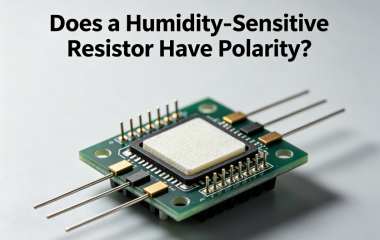
In the electronics components industry, the humidity-sensitive resistor is a widely used humidity sensor known for its simple structure, low cost, and broad application range. It plays an important role in temperature and humidity control systems, industrial automation, and instrumentation. This type of sensor converts changes in environmental humidity into variations in resistance value, enabling indirect humidity measurement. As a result, it holds significant practical value in electronic system design.
I. What Is a Humidity-Sensitive Resistor?
A humidity-sensitive resistor is a resistance-type sensor that utilizes the moisture-sensitive properties of materials. Its core characteristic is that its resistance value changes significantly with variations in ambient humidity. Typically, it is made of polymer materials, metal oxides, or semiconductor composite materials as the sensing layer. When the moisture content in the air changes, it affects the conductive pathways within the material, thereby altering its resistance characteristics.
In simple terms, a humidity-sensitive resistor is a “resistor that changes with humidity.” By measuring its resistance variation, the surrounding humidity level can be determined.
II. Working Principle of a Humidity-Sensitive Resistor
The working principle of a humidity-sensitive resistor is based on the relationship between moisture absorption and conductivity. When environmental humidity increases, water molecules in the air are absorbed by the sensing material, forming continuous or semi-continuous conductive channels. This enhances ion or electron mobility, leading to a decrease in resistance.
Conversely, when humidity decreases, the number of water molecules on the material surface reduces, breaking the conductive channels and weakening ion mobility, which results in an increase in resistance.
In practical applications, humidity-sensitive resistors are usually used with voltage divider circuits or analog sampling circuits. The resistance variation is converted into a voltage signal, which is then digitized through an ADC to output humidity data.
III. Polarity Characteristics of Humidity-Sensitive Resistors
Humidity-sensitive resistors are typically non-polar components, meaning their two terminals do not have strict positive or negative polarity. In DC circuits, they can generally be connected in either direction without affecting basic functionality.
However, several practical considerations should still be noted:
First, some composite humidity-sensitive devices may integrate heating structures or temperature compensation structures. These devices may have defined functional pins, such as heating terminals and sensing terminals, which must be connected according to the manufacturer’s datasheet to ensure measurement stability.
Second, in some high-precision humidity detection modules, the humidity-sensitive resistor is integrated with other sensors in a packaged form. In such cases, circuit design often defines specific interfaces or polarity markings that must be strictly followed.
It should be emphasized that although humidity-sensitive resistors themselves are generally non-polar, incorrect wiring or misconnection of heating circuits may lead to increased measurement errors and may even reduce component lifespan.
IV. Advantages and Disadvantages of Humidity-Sensitive Resistors
As a basic humidity sensing device, humidity-sensitive resistors offer clear advantages but also have certain limitations.
In terms of advantages, they feature a simple structure and low manufacturing cost, making them suitable for mass production. They also provide relatively high sensitivity and fast response to humidity changes. In addition, their small size allows easy integration into various electronic devices, making them suitable for space-constrained applications.
In terms of disadvantages, humidity-sensitive resistors are easily affected by ambient temperature changes, which may cause measurement drift. Their long-term stability is relatively limited, and performance may degrade in high-humidity or polluted environments. Furthermore, their output is typically an analog resistance change, requiring external circuitry for signal conversion and calibration, which increases system design complexity.
V. Application Areas of Humidity-Sensitive Resistors
Humidity-sensitive resistors are widely used in both electronics and industrial fields.
In temperature and humidity control systems, they are commonly used in air conditioners, dehumidifiers, smart home devices, and automotive electronics systems to monitor ambient humidity in real time and enable automatic regulation.
In liquid level detection applications, humidity-sensitive resistors can utilize their sensitivity to moisture or water contact for simple liquid level alarms or liquid surface detection systems, especially in low-cost industrial solutions.
In instrumentation, they are used in humidity measurement modules and combined with control circuits to monitor environmental parameters, making them an important component of basic sensing systems.
In industrial automation, humidity-sensitive resistors can work together with temperature and pressure sensors to build comprehensive environmental monitoring systems, improving production stability and intelligence.
VI. Conclusion
Overall, as a classic humidity detection component, the humidity-sensitive resistor remains an important device in the electronics components industry due to its simple structure, low cost, and ease of use. Although it has limitations in terms of accuracy and stability, it can still meet most low-to-medium precision humidity detection requirements when properly designed with appropriate circuitry and compensation algorithms. When selecting a humidity-sensitive resistor, factors such as application environment, accuracy requirements, and system design complexity should be carefully considered to achieve optimal performance.


