
What Is the Difference Between Chip Inductors and Chip Capacitors?


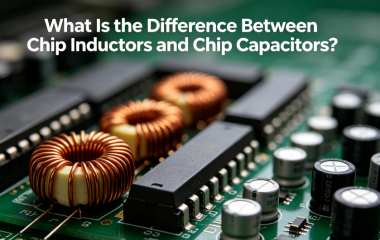
In the electronic components industry, surface-mount devices (SMDs) have become the core fundamental building blocks in circuit design. Among them, chip inductors and chip capacitors are often confused in practical applications and component selection due to their similar size and identical packaging formats. Especially in consumer electronics, communication equipment, and power management systems, although these two components appear similar, their electrical characteristics and functional roles are fundamentally different. A correct understanding of their differences is essential for circuit stability, performance optimization, and product reliability design.
I. What Are Chip Inductors and Chip Capacitors?
A chip inductor (Chip Inductor), also known as a power inductor or surface-mount inductor, is a passive component based on the principle of electromagnetic induction. It is primarily used to store magnetic energy and resist changes in current. Its core structure typically consists of wire-wound coils or multilayer constructions. Chip inductors are widely used in DC-DC converters, power filtering, and signal processing circuits.
A chip capacitor (Chip Capacitor), on the other hand, is a capacitor mainly made of ceramic materials. It stores electrical charge through an electric field to achieve energy storage and release. Its typical characteristics include high temperature resistance (generally from -55°C to 125°C) and low dissipation factor (DF typically below 2.5%). It is widely used in decoupling, filtering, and coupling circuits of various integrated circuits. It can replace some traditional through-hole capacitors, helping achieve circuit miniaturization.
II. Key Characteristics of Chip Inductors
As a critical component in power and signal processing, chip inductors exhibit the following typical characteristics:
First, they feature miniaturization and high power density, allowing relatively high inductance values within limited PCB space, meeting the design requirements of highly integrated electronic products. Second, chip inductors offer strong energy storage capability and low DC resistance, helping reduce energy loss and improve conversion efficiency.
In addition, chip inductors generally provide good current handling capability and are suitable for high-frequency switching power supplies, voltage conversion modules, and noise suppression circuits. In manufacturing, these components are typically packaged in tape-and-reel format, making them suitable for SMT automated assembly processes, thereby improving production efficiency and consistency.
In terms of applications, chip inductors are widely used in computer motherboards, graphics cards, laptops, power management ICs, and DC-DC converters, making them an indispensable component in modern power design.
III. Differences Between Chip Inductors and Chip Capacitors
Although chip inductors and chip capacitors share very similar appearance and packaging dimensions, they differ fundamentally in physical principles and electrical behavior.
In terms of unit markings, capacitance values of chip capacitors are usually expressed in μF, nF, or pF, while inductance values of chip inductors are expressed in μH, mH, or nH. This is one of the most direct ways to distinguish them.
In terms of testing methods, when measured with a multimeter in resistance mode, chip capacitors typically show an open-circuit state, while chip inductors may show low resistance or near short-circuit behavior. In continuity mode, inductors usually trigger a buzzer, while capacitors do not.
In terms of appearance, chip capacitors are generally uniform rectangular ceramic structures with varying shades of color, while chip inductors may present wound structures or obvious metallic terminal features. Some models may also have inductance values printed directly on the surface.
In terms of circuit function, chip capacitors are mainly used for storing electric field energy, filtering, and decoupling, focusing on improving voltage stability. Chip inductors, in contrast, focus on suppressing current changes, storing magnetic energy, and working with power conversion circuits for energy regulation. The two components are often used in a complementary manner within circuits.
IV. Conclusion
Although chip inductors and chip capacitors look similar in appearance, their working principles and circuit functions are fundamentally different. Chip inductors are based on magnetic energy storage and emphasize current change control and energy conversion efficiency, while chip capacitors are based on electric field energy storage and are mainly used for voltage stabilization and signal filtering. In the context of modern electronic products trending toward higher frequency, miniaturization, and greater integration, correctly distinguishing and selecting these two components is crucial for improving overall circuit performance and product reliability.


