
What Is the Difference Between SSR and Solid State Voltage Regulator?


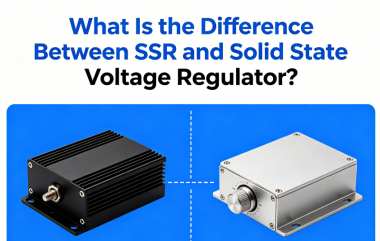
In the electronic components industry, solid-state devices are gradually replacing traditional electromechanical components. Among them, solid state relays and solid state voltage regulators are two widely used and critical electronic components. Due to their significant differences in structure, function, and application scenarios, engineers often confuse them when selecting devices. This article provides a systematic analysis from the perspectives of definition, characteristics, and application fields to help readers better understand their differences and usage logic.
I. What Are Solid State Relays and Solid State Voltage Regulators?
A Solid State Relay (SSR) is a non-contact electronic switch composed entirely of semiconductor devices. It is used to control the on/off state between control signals and load circuits. It typically achieves electrical isolation between input and output through a photoelectric coupler, thereby replacing traditional electromechanical relays with an electronic solution.
A Solid State Voltage Regulator is a voltage control device based on thyristors (SCR) or power semiconductor devices. It regulates the output voltage by controlling the conduction angle, enabling continuous or step-based voltage adjustment. It is mainly used to stabilize voltage or adjust load power to meet the operational requirements of different electrical equipment.
II. Characteristics of Solid State Relays
As switching devices, solid state relays are known for their fast response and high reliability. Since they contain no mechanical contacts, they do not generate arcs or suffer from mechanical wear during operation, resulting in a significantly longer service life compared to traditional relays.
Solid state relays offer excellent electrical isolation performance. Through optocoupler structures, they effectively isolate the input control side from the output load side, enhancing system safety while reducing electromagnetic interference. In addition, their switching speed typically reaches the microsecond level, making them suitable for high-frequency control applications. They are also compact in size and operate silently, making them ideal for space-constrained environments or applications requiring low noise.
However, solid state relays also have certain limitations. For example, they generate a forward voltage drop during conduction, which leads to power dissipation. Therefore, heat dissipation design is often required in high-current applications.
III. Characteristics of Solid State Voltage Regulators
The core function of solid state voltage regulators is voltage regulation. By controlling the conduction angle of thyristors, they achieve continuous variation of output voltage, enabling precise voltage control.
In terms of performance, solid state voltage regulators offer high adjustment accuracy and excellent dynamic response. They can quickly respond to input voltage fluctuations, ensuring stable operation of load equipment. In addition, modern solid state voltage regulators often integrate digital control systems, allowing remote monitoring and parameter configuration via PLCs or industrial computers, thereby improving system intelligence and operational flexibility.
Furthermore, solid state voltage regulators demonstrate good energy efficiency. Compared with traditional voltage regulation methods, they significantly reduce energy losses and also provide multiple protection functions such as overcurrent protection and current limiting protection, enhancing overall system safety and reliability.
IV. Differences in Application Fields
Solid state relays are mainly used in switching control applications, such as industrial automation systems, CNC equipment, temperature control systems, household appliances, and packaging machinery. Their primary function is to control circuit on/off states under control signals, making them more suitable for logical and execution control scenarios.
Solid state voltage regulators are mainly used in applications requiring voltage regulation or power control, such as electric heating control systems, lighting dimming systems, motor speed control systems, laboratory equipment, and industrial power stabilization systems. Their core purpose is to adjust voltage to change load power or maintain voltage stability.
Overall, solid state relays focus on “switching control,” while solid state voltage regulators focus on “continuous regulation,” reflecting fundamental differences in control logic.
V. Conclusion
In summary, although solid state relays and solid state voltage regulators both belong to solid-state electronic control devices, they differ significantly in function, working principles, and application scenarios. Solid state relays are more suitable for high-frequency switching control and signal isolation applications, while solid state voltage regulators are better suited for voltage regulation and power control systems. In practical selection, engineers should consider load type, control requirements, and system structure to ensure stable and efficient operation of electrical systems.


