
What Is the Difference Between SSR and Intermediate Relay?


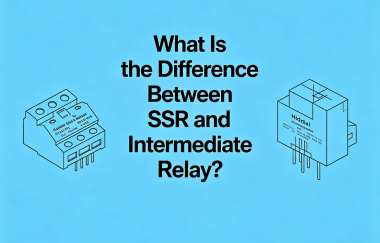
In the electronic components industry, relays are critical devices for signal control and power switching, and their selection directly affects system reliability, lifespan, and cost. Among them, solid state relays and intermediate relays are the two most widely used types. With the advancement of smart manufacturing, Industry 4.0, and the increasing demand for high-reliability equipment, more engineers and procurement professionals are searching on Google for terms such as “difference between solid state relay and intermediate relay” and “which relay is more durable”. This article provides a systematic comparison from aspects including definition, working principle, structural characteristics, application range, advantages, and disadvantages.
I. What Are Solid State Relays and Intermediate Relays?
A Solid State Relay (SSR) is a non-contact electronic switching device that uses semiconductor components to achieve electrical isolation and switching functions. It operates by using input control signals to drive internal optocouplers, thyristors, or MOSFETs, thereby turning the load circuit on or off.
An intermediate relay, on the other hand, is a traditional electromagnetic relay mainly used for signal amplification, logic control, and multi-circuit switching. It operates by energizing a coil to generate a magnetic field, which drives mechanical contacts to open or close the circuit.
II. Working Principle of Solid State Relays and Intermediate Relays
The working principle of solid state relays is based on semiconductor electronic switching technology. When a control voltage or current is applied to the input terminal, the internal drive circuit activates the opto-isolation module and triggers the power semiconductor device to conduct or turn off, achieving non-contact switching. Due to its electronic switching method, SSRs typically feature zero-voltage turn-on or zero-current turn-off characteristics, effectively reducing electromagnetic interference and arc generation.
Intermediate relays operate based on the principle of electromagnetic induction. When the coil is energized, the iron core generates a magnetic field that attracts the armature, causing the contacts to mechanically close or open, thereby controlling the external circuit. When power is removed, the magnetic field disappears and the contacts return to their original position under spring force.
III. Structural Characteristics and Application Range of Solid State Relays and Intermediate Relays
Structurally, solid state relays mainly consist of input control circuits, photoelectric isolation devices, driver circuits, and power semiconductor modules. Due to the absence of mechanical contacts, they are compact, highly resistant to vibration, and have an extremely long service life, while maintaining stable performance in high-speed switching applications. In addition, solid state relays operate with low noise and are suitable for environments sensitive to electromagnetic interference.
Intermediate relays consist of electromagnetic coils, iron cores, armatures, and mechanical contact systems. Their structure is relatively simple but offers strong load-driving capability, especially in high-current or multi-contact switching scenarios. However, due to their mechanical nature, they are generally larger in size and suffer from contact wear over time.
In terms of applications, solid state relays are widely used in CNC machines, temperature control systems, industrial heating equipment, communication devices, medical instruments, and automated test systems, particularly in high-frequency and high-reliability environments. Intermediate relays are more commonly used in traditional industrial control systems, power control cabinets, relay protection systems, and PLC logic control circuits, especially in medium-load and general-purpose control scenarios.
IV. Advantages and Disadvantages of Solid State Relays and Intermediate Relays
The main advantages of solid state relays include no mechanical wear, fast switching speed, long service life, strong vibration resistance, and silent operation without arc generation. They also offer high control precision and are suitable for high-frequency switching applications. However, SSRs also have limitations, such as higher cost, voltage drop during conduction, higher heat generation, and stricter heat dissipation requirements. In addition, some models have lower overload capability compared to electromagnetic relays.
Intermediate relays are advantageous due to their low cost, mature design, strong load capacity, and good overload resistance. They also offer relatively high stability in complex industrial environments and are easy to maintain and replace. However, their disadvantages are also evident, including mechanical contact wear leading to limited lifespan, slower switching speed, operational noise, and arc generation, which may affect long-term reliability.
V. Conclusion
Overall, solid state relays and intermediate relays differ significantly in terms of technology and application positioning. Solid state relays are based on semiconductor technology and are suitable for high-frequency, high-reliability, and low-noise applications, while intermediate relays rely on electromagnetic mechanical structures and are better suited for general industrial control and high-load switching scenarios. In practical selection, factors such as load characteristics, switching frequency, environmental conditions, and cost budget should be comprehensively evaluated. With the development of industrial automation and intelligent equipment, the adoption of solid state relays is gradually increasing; however, intermediate relays still play an irreplaceable role in traditional control systems.


