
Thyristor vs Solid State Relay: What’s the Difference?


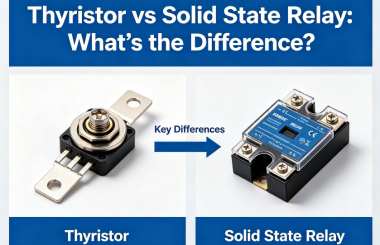
In the electronic components industry, Thyristors and Solid State Relays (SSRs) are two of the most commonly used power control devices. Many engineers, procurement professionals, and electronics enthusiasts often ask: What is the difference between a thyristor and a solid state relay? Can they replace each other? How should you choose between them?
Although both thyristors and solid state relays can perform circuit switching and power control functions, they differ significantly in terms of internal structure, operating principles, control methods, isolation capabilities, and application scenarios. Understanding their characteristics and differences is essential for improving system reliability, optimizing design costs, and enhancing overall equipment performance.
I. What Is a Thyristor?
A thyristor, also known as a Silicon Controlled Rectifier (SCR), is a power semiconductor device consisting of four semiconductor layers and three terminals: anode (A), cathode (K), and gate (G). Its primary function is to control electrical power under high-voltage and high-current conditions, making it widely used in rectifiers, motor speed controllers, lighting dimmers, welding equipment, frequency converters, and industrial power systems.
The operating principle of a thyristor is based on gate triggering. When a trigger signal is applied to the gate terminal, the device turns on and begins conducting current. Once the current flowing between the anode and cathode exceeds the holding current, the thyristor remains in the conductive state even if the gate signal is removed. It only turns off when the main circuit current drops below the holding current. For this reason, a thyristor is classified as a semi-controlled power device.
II. What Is a Solid State Relay?
A Solid State Relay (SSR) is an electronic switching device that uses semiconductor components to perform contactless switching operations. Unlike conventional electromagnetic relays, SSRs contain no mechanical contacts. Instead, they utilize components such as optocouplers, thyristors, triacs, MOSFETs, or IGBTs to control load currents.
A typical SSR consists of an input control circuit, an optical isolation circuit, and an output switching stage. When a control signal is applied to the input, the optocoupler transfers the signal to the output stage, allowing the connected load to turn on or off. Thanks to its optical isolation design, an SSR provides enhanced electrical safety and noise immunity, making it widely used in industrial automation equipment, PLC systems, temperature controllers, medical devices, and smart home appliances.
III. Characteristics of Thyristors
One of the most significant advantages of thyristors is their exceptional power handling capability. They can withstand high voltages and large currents, making them ideal for high-power electrical control applications. Many industrial systems rely on thyristors to ensure stable and efficient operation.
Thyristors exhibit a distinct unidirectional conduction characteristic, allowing current to flow only from the anode to the cathode. For AC power control applications, anti-parallel SCR configurations or triacs are often used to achieve bidirectional conduction.
Gate-triggered conduction is another important characteristic. The device remains in a non-conductive state until sufficient gate current is applied. This feature makes thyristors highly suitable for phase-angle control and power regulation applications.
The self-latching capability of a thyristor distinguishes it from many other power devices. Once turned on, it continues conducting even after the gate signal is removed, reducing the burden on the control circuitry.
In addition, thyristors typically offer low on-state voltage drops and high efficiency, helping minimize power losses in high-power systems. However, because turn-off depends on current naturally falling below the holding current, switching speed is relatively slow, making thyristors less suitable for high-frequency switching applications.
IV. Characteristics of Solid State Relays
The most notable feature of a solid state relay is its contactless design. Since there are no mechanical contacts, SSRs eliminate issues such as contact wear, arcing, and contact bounce, resulting in longer service life and improved reliability.
The switching speed of an SSR is significantly faster than that of traditional electromechanical relays and often faster than many thyristor-based switching solutions. This makes SSRs well suited for automation systems and precision control applications that require rapid response.
Optical isolation technology is another major advantage. By transmitting control signals through light rather than direct electrical connections, SSRs provide electrical isolation between input and output circuits, enhancing both safety and electromagnetic interference resistance.
SSRs also require relatively low drive power and can be directly interfaced with PLCs, microcontrollers, and industrial control systems, simplifying overall circuit design.
Furthermore, SSRs are compact and lightweight, making them ideal for modern electronic equipment where space savings are important. However, because semiconductor switching devices generate heat during operation, thermal management must be considered in high-current applications to ensure long-term reliability.
V. Differences Between Thyristors and Solid State Relays
From a structural perspective, a thyristor is an individual power semiconductor device, whereas a solid state relay is an integrated switching module that typically includes optical isolation, driver circuitry, and a power output stage. Therefore, they serve different roles within a system.
In terms of control methods, a thyristor requires a gate trigger signal to turn on and depends on current reduction to turn off. In contrast, an SSR can be activated and deactivated directly through input control signals, making it easier to use.
Regarding isolation capability, standard thyristors do not provide electrical isolation by themselves. Most SSRs, however, incorporate optocouplers that electrically isolate the control side from the load side, enhancing system safety.
When it comes to switching speed, SSRs generally offer faster response times, making them better suited for frequent switching operations and automated control systems. Thyristors, on the other hand, are more suitable for continuous power regulation and high-power control applications.
In terms of load capacity, thyristors can typically handle higher voltage and current levels, giving them a clear advantage in industrial power supplies, motor drives, and high-power rectification systems. SSRs focus more on ease of control and system integration.
Application areas also differ. Thyristors are widely used in motor speed control, power regulation, industrial rectification systems, welding equipment, and renewable energy systems. SSRs are commonly found in PLC-controlled equipment, temperature control systems, industrial automation lines, medical devices, and smart appliance controls.
VI. How to Choose Between a Thyristor and a Solid State Relay
If the application involves high-power loads, phase-angle control, or large current handling, a thyristor is often the more economical and reliable choice. Industrial dimmers, motor soft starters, and AC voltage regulators are typical examples where thyristor technology is extensively used.
If the system prioritizes ease of control, fast switching response, electrical isolation, and long-term reliability, a solid state relay is generally the better option. SSRs are particularly suitable for PLC control cabinets, automated equipment, temperature control systems, and applications that require frequent switching operations.
In practical engineering designs, many SSRs actually use thyristors or triacs as their output switching elements. Therefore, these technologies are not necessarily competing alternatives but rather complementary solutions that operate at different levels of system integration.
VII. Conclusion
Both thyristors and solid state relays are indispensable components in modern power electronics systems. Thyristors play a critical role in industrial power control due to their high voltage and current handling capabilities as well as their excellent power regulation performance. Solid state relays, meanwhile, have become essential components in automation systems because of their contactless operation, optical isolation, and fast switching characteristics.
For engineers and purchasing professionals, the choice between a thyristor and an SSR ultimately depends on the specific application requirements. If high-power control and cost efficiency are the primary concerns, a thyristor is often the preferred solution. If safety isolation, rapid switching, and reliable control are more important, a solid state relay is usually the better choice. Understanding the strengths and limitations of both devices enables designers to achieve the optimal balance between performance, reliability, and cost.


