
What Is the Function of a Relay in a Circuit?


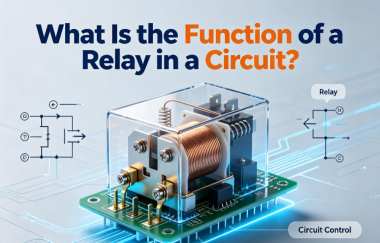
In the electronic components industry, a relay is one of the most commonly used control devices in electronic and electrical control systems. It is widely applied in industrial automation, automotive electronics, home appliances, telecommunications equipment, and new energy systems. Its primary function is to use a small control current or signal to switch a larger current or high-power circuit, enabling automatic circuit switching, electrical isolation, protection, and control.
I. What Is a Relay?
A relay is an automatic switching device that controls the opening and closing of an output circuit based on changes in an input signal. Essentially, it functions as an electronically controlled switch. Depending on the design, a relay may operate using electromagnetic force, semiconductor technology, or other physical principles to isolate the control circuit from the load circuit while ensuring safe and reliable circuit operation.
Because the control circuit and load circuit are electrically isolated, relays can control high-voltage and high-current equipment while protecting low-voltage control circuits from high voltage, surge currents, and electrical interference. As a result, relays have become indispensable components in modern electronic and electrical systems.
II. How Does a Relay Work?
A traditional electromagnetic relay mainly consists of an electromagnetic coil, iron core, armature, contacts, and a return spring.
When voltage is applied to the control terminal, current flows through the electromagnetic coil, generating a magnetic field that attracts the armature. This movement changes the state of the contacts: normally open contacts close, while normally closed contacts open, allowing the load circuit to be switched on or off.
When the control signal is removed, the magnetic field disappears. The return spring then moves the armature back to its original position, restoring the contacts to their default state and returning the load circuit to its initial operating condition.
Throughout this process, only a relatively small control current is required to switch a much larger current or high-voltage circuit. This enables the relay to achieve the principle of "using a small current to control a large current" while also providing excellent electrical isolation and improving overall system safety.
III. Types of Relays
Relays can be classified into several categories based on their operating principles and contact configurations.
1. Classification by Operating Principle
Electromagnetic Relay
Electromagnetic relays are the most widely used type of relay. They use an electromagnetic coil to drive mechanical contacts for switching operations. Their advantages include high load capacity, low cost, and compatibility with both AC and DC circuits, making them suitable for industrial equipment, power systems, automotive electronics, and many other applications.
Solid State Relay (SSR)
Solid state relays replace mechanical contacts with semiconductor devices and use optical isolation to control the output. Since they contain no moving mechanical parts, SSRs offer faster switching speeds, longer service life, quieter operation, and greater resistance to vibration. They are commonly used in automation equipment, medical devices, and precision control systems.
2. Classification by Contact Configuration
Normally Open (NO)
A normally open relay keeps its contacts open when the relay is not energized. Once the coil is energized, the contacts close and the load circuit begins operating. This is the most common type of relay.
Normally Closed (NC)
A normally closed relay keeps its contacts closed when the relay is de-energized. When the coil is energized, the contacts open, disconnecting the load circuit. This configuration is commonly used in applications where the circuit should remain active by default.
Changeover Relay (SPDT)
A changeover relay includes both normally open and normally closed contacts, allowing it to switch between two separate circuits. This design provides greater flexibility and is widely used in automatic control systems and signal switching applications.
IV. Relay Operating Modes
Depending on the number of contacts and the switching method, relays generally operate in the following modes.
1. Single Switching Mode
A single switching relay typically contains one set of contacts and features a simple control mechanism. When the control signal is applied, the contacts either close or open to complete a single switching action. This type is commonly used for lighting control, motor starting and stopping, and general switching applications.
2. Double Switching Mode
A double switching relay contains two or more sets of contacts, allowing it to switch between multiple circuits simultaneously. During operation, one contact closes while another opens, making this configuration suitable for automatic transfer systems, power source switching, and equipment interlocking applications.
3. Latching Relay
A latching relay, also known as a bistable relay, maintains its switching state after being actuated without requiring continuous power. It changes state only when another control signal is received. Compared with conventional relays, latching relays consume significantly less power and are widely used in smart meters, smart home systems, and new energy equipment.
V. Applications of Relays in Different Industries
As electronic technology continues to evolve, relays are now used across almost every electrical control application.
In industrial automation, relays are widely used in PLC control systems, motor control, automated production lines, and equipment protection, helping improve productivity and operational reliability.
In automotive electronics, relays are commonly found in lighting systems, engine starting circuits, power seats, air conditioning systems, windshield wipers, and high-voltage power distribution systems in electric vehicles, providing reliable power switching and circuit protection.
In home appliances, relays control compressors, motors, and heating elements in air conditioners, refrigerators, washing machines, microwave ovens, and smart home devices, enabling automatic operation and improved energy efficiency.
In telecommunications and networking equipment, relays are used in base stations, power management systems, network switches, and servers for signal routing, power protection, and remote control.
In the new energy sector, relays play an important role in photovoltaic inverters, energy storage systems, EV charging stations, and Battery Management Systems (BMS), ensuring safe and stable operation under high-voltage and high-current conditions.
Additionally, relays are extensively used in medical equipment, railway transportation, power protection systems, aerospace, and many other industries, where they provide reliable control and protection for mission-critical systems.
VI. Conclusion
As one of the fundamental components in electronic control systems, relays play an irreplaceable role by providing small-current control of large-current circuits, electrical isolation, automatic switching, and circuit protection. From traditional electromagnetic relays to solid state relays and latching relays, different relay technologies are designed to meet the requirements of a wide range of applications.


