
What Is a Synchronous Transformer?


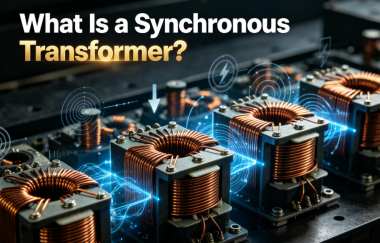
In the electronic components industry, the synchronous transformer is an important device in power electronic control systems. It not only performs voltage conversion, but more importantly provides a reference signal synchronized with the grid voltage waveform, ensuring that thyristors, silicon controlled rectifiers (SCRs), and other power electronic devices are triggered at the correct phase angle. With the development of industrial automation, motor drives, and new energy power systems, the application value of synchronous transformers in modern electronic equipment has become increasingly prominent.
I. What Is a Synchronous Transformer?
A synchronous transformer is a transformer specifically designed to provide synchronous signals. It is commonly used in thyristor triggering circuits, phase control circuits, and power system measurement and protection devices. Based on the principle of electromagnetic induction, it converts AC grid voltage signals into low-voltage synchronous signals required by control circuits, while maintaining the same frequency and phase relationship as the primary-side voltage.
Compared with ordinary power transformers, synchronous transformers place greater emphasis on signal synchronization and electrical isolation. They must not only ensure that the output signal is synchronized with the input signal in time, but also provide reliable insulation protection for low-voltage control circuits, thereby preventing high-voltage circuits from interfering with or damaging electronic control systems.
II. Functions of a Synchronous Transformer
The core functions of a synchronous transformer in power electronic systems are mainly reflected in the following aspects.
1.Providing Synchronous Signals
The primary function of a synchronous transformer is to provide trigger signals synchronized with the AC power grid for thyristors, SCRs, and other power electronic devices. Since the conduction timing of these devices directly affects output voltage and current, the accuracy of the synchronous signal is critical for phase control.
2.Achieving Voltage Conversion
A synchronous transformer can convert high-voltage AC signals into low-voltage signals to meet the operating requirements of control circuits and driver circuits. By properly designing the turns ratio between the primary and secondary windings, a voltage level suitable for electronic control systems can be obtained.
3.Providing Electrical Isolation
In high-voltage power systems, control circuits usually need to be electrically isolated from the main circuit. Through magnetic coupling between the primary and secondary windings, the synchronous transformer transmits signals while blocking direct electrical connection, thereby improving system safety and anti-interference capability.
4.Assisting Phase Control
In thyristor voltage regulation, motor speed control, and AC power control systems, the synchronous signal provided by the synchronous transformer can serve as the reference for phase control. The control circuit adjusts the delay angle of the trigger pulse according to this reference signal, thereby achieving precise regulation of output power.
III. Working Principle of a Synchronous Transformer
The working principle of a synchronous transformer is based on the law of electromagnetic induction. When the primary winding is connected to an AC power source, the alternating current generates an alternating magnetic flux in the core. This magnetic flux changes periodically with the AC voltage and induces a corresponding alternating electromotive force in the secondary winding.
Because the primary and secondary windings share the same core, the induced voltage in the secondary winding maintains the same frequency and phase relationship as the primary-side voltage. This synchronization characteristic enables the secondary output signal to accurately reflect changes in the grid voltage waveform, providing a reliable synchronous reference for subsequent triggering circuits.
The voltage conversion function depends on the turns ratio between the primary and secondary windings. According to the basic transformer principle, the ratio of secondary voltage to primary voltage is equal to the ratio of secondary winding turns to primary winding turns. By adjusting the winding design, a low-voltage synchronous signal suitable for control circuits can be obtained.
In addition, since there is no direct electrical connection between the primary and secondary sides, the synchronous transformer can effectively provide electrical isolation. This isolation not only protects low-voltage control circuits, but also reduces the impact of electromagnetic interference in high-voltage systems on signal transmission.
IV. Structural Characteristics of a Synchronous Transformer
Synchronous transformers usually adopt a compact structural design to meet the requirements of electronic equipment for size and weight. Their cores are generally made of high-permeability materials to improve magnetic coupling efficiency and reduce energy loss.
In terms of insulation design, synchronous transformers must have a high insulation rating, especially when used in high-voltage power systems. Adequate withstand voltage capability between the primary and secondary windings is essential to ensure safe equipment operation.
To improve efficiency, the windings of synchronous transformers are usually wound with low-resistance conductors, and the core materials are carefully optimized to reduce copper loss and core loss. In addition, some synchronous transformers are designed with heat dissipation structures to maintain stable performance during long-term operation.
V. Application Scenarios of Synchronous Transformers
1.Power Systems
In high-voltage direct current (HVDC) transmission and flexible AC transmission systems, synchronous transformers are used to provide synchronous trigger signals for thyristor valves, thereby enabling precise control of power flow direction and transmission power.
2.Power Electronic Equipment
In rectifiers, inverters, and AC voltage regulators, synchronous transformers provide synchronous reference signals for control circuits, ensuring that power electronic devices conduct according to the predetermined phase angle.
3.Motor Control Systems
In AC motor speed control and servo drive systems, synchronous transformers can provide trigger signals synchronized with the power grid, which are used to control motor starting, speed regulation, and operating direction.
4.Measurement and Protection Devices
In power system relay protection, measuring instruments, and monitoring equipment, synchronous transformers provide reference signals synchronized with the grid voltage, offering accurate support for fault detection and energy measurement.
VI. Conclusion
As an important component in the electronic components industry, the synchronous transformer plays a vital role in power electronic control systems by providing synchronous signals, voltage conversion, electrical isolation, and phase control. Its working principle is based on electromagnetic induction, using magnetic coupling between the primary and secondary windings to generate a low-voltage signal synchronized with the grid voltage waveform.


