DIY Modify the Mean Well LRS-600-48 to 63V


Suppose you have modified a Mean Well LRS-350-48 switching power supply by increasing its output voltage to power a Riden RK-6012. During operation, you find that the power headroom is not quite sufficient. Fortunately, you have another LRS-600-48 switching power supply on hand.
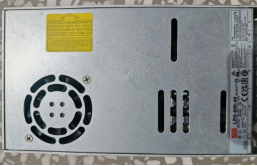
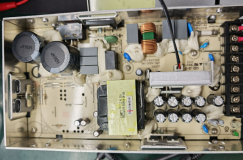
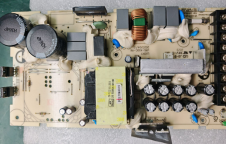
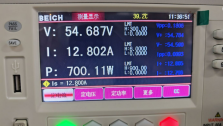
The power supply is in excellent cosmetic condition, with a clean and tidy interior. It does not feature a PFC circuit and uses an LLC topology. Its original maximum output voltage is 54.68V, and it can deliver up to 700W of power.
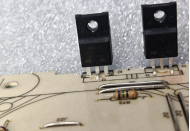
The main switching MOSFET is an STF33N60M2, rated at 600V, 26A, and 35W.
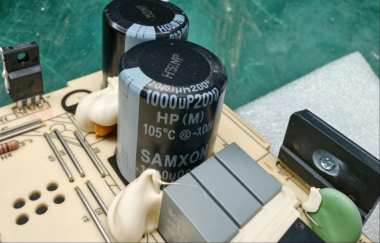
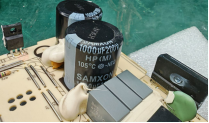
The input filter consists of two 200V 1000µF electrolytic capacitors.
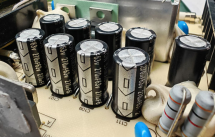
The output filter consists of nine 63V 270µF electrolytic capacitors.
The high-voltage-side LLC controller is an HR1001C.
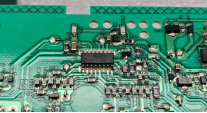
The low-voltage-side dedicated operational amplifier is an AP4310AM.
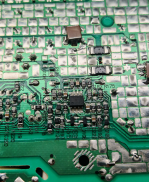
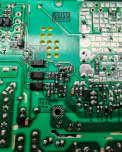
This is an overall view of the back of the circuit board.
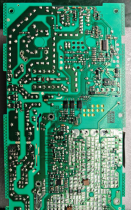
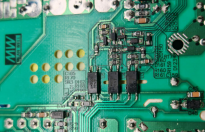
By tracing the output feedback circuit, you can draw a simplified schematic. The board has three optocouplers in total. U3 handles voltage feedback, while U4 provides overvoltage protection.
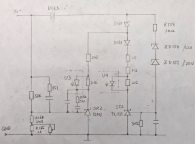
In the original circuit, R164 has a resistance of 2.43KΩ, setting the maximum output voltage to approximately 54.6V. To increase the output voltage to 63V, you can replace R164 with a 2.1KΩ equivalent resistance using a 2.2KΩ resistor in parallel with a 47KΩ resistor. The resulting output voltage range is 48V–62.85V.
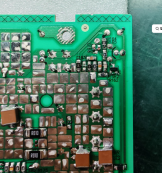
Three 100V 10µF MLCC capacitors are connected in parallel at the output.
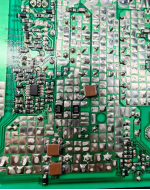
The original overvoltage protection threshold is 32V + 28V = 60V. By replacing ZD150 and ZD151, you can adjust the protection threshold to 47V + 16V = 63V.
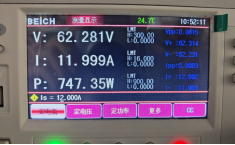
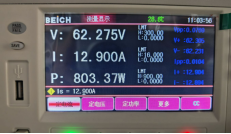
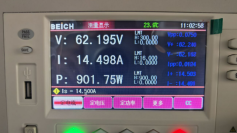
Testing with an electronic load shows a maximum output power of 900W. The power supply operates normally at 800W for four hours, with its enclosure temperature remaining close to ambient temperature. This demonstrates the good conversion efficiency of the LLC topology. Therefore, you can leave the output filter capacitors unchanged for now.