
What Are the Common Capacitor Failures During Operation?


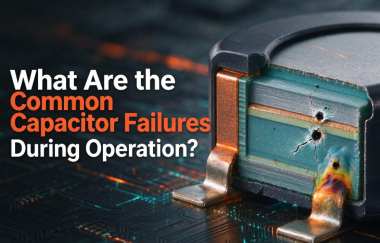
In the electronics industry, capacitors are essential passive components widely used in power management, signal processing, filtering, coupling, energy storage, and voltage stabilization. They play important roles in consumer electronics, industrial control equipment, automotive electronics, and communication systems. However, factors such as operating voltage, temperature, ripple current, ambient humidity, and service life can cause capacitors to develop various faults, including leakage, short circuits, capacitance loss, bulging, and even rupture. These problems can affect circuit performance and may lead to equipment malfunctions or system damage. Understanding how capacitors work, identifying common failures, and applying appropriate corrective measures can help engineers and electronics maintenance professionals troubleshoot problems more efficiently and extend equipment service life.
Catalog
II. How Does a Capacitor Work?
III. Common Capacitor Failures and Their Solutions
I. What Is a Capacitor?
A capacitor is a passive electronic component designed to store and release electrical energy. It mainly consists of two conductive electrodes separated by an insulating material called a dielectric. When a voltage is applied across the capacitor, opposite electrical charges accumulate on the two electrodes, creating an electric field in which energy is stored. When the external circuit requires energy, the capacitor can release its stored charge to support circuit operation.
Depending on their dielectric materials and construction, common capacitor types include ceramic capacitors, aluminum electrolytic capacitors, tantalum capacitors, film capacitors, and supercapacitors. These types differ in capacitance range, rated voltage, equivalent series resistance (ESR), temperature characteristics, and service life. Therefore, selecting the appropriate capacitor requires careful consideration of the specific requirements of the application.
II. How Does a Capacitor Work?
A capacitor operates by storing electrical energy in an electric field. When a power source is connected to a capacitor, electrical charges gradually accumulate on its two electrodes, creating a voltage across the component. During charging, the capacitor absorbs and stores electrical energy. When the external circuit requires energy, the capacitor discharges and releases the stored charge.
In practical electronic circuits, capacitors serve several important functions. In power supply circuits, they help reduce voltage fluctuations and electrical noise, improving output voltage stability. In signal processing circuits, capacitors provide AC coupling and DC blocking. In decoupling circuits, they supply transient current to integrated circuits and help minimize power supply noise that could interfere with other components.
It is important to note that different capacitor types have distinct electrical characteristics. For example, aluminum electrolytic capacitors typically offer relatively high capacitance but require careful consideration of polarity, ripple current, and service life. Ceramic capacitors are compact and generally offer good high-frequency performance. However, the actual capacitance of some high-dielectric-constant ceramic capacitors can decrease significantly under DC bias.
III. Common Capacitor Failures and Their Solutions
During long-term operation, capacitors may experience electrical stress, thermal stress, mechanical damage, and environmental influences, resulting in performance degradation or component failure. The following are four common capacitor problems, along with their possible causes and recommended solutions.
1. Capacitor Leakage
Capacitor leakage refers to an excessive leakage current flowing through a capacitor when a DC voltage is applied. Common causes include dielectric aging, moisture absorption, internal damage, and prolonged exposure to high temperatures or overvoltage conditions. In electrolytic capacitors, abnormal leakage current may also be associated with changes in the electrolyte or internal structure.
Solutions: Select reliable capacitors that meet the electrical requirements of the application, and avoid operating them continuously beyond their rated voltage and temperature limits. If abnormal leakage is suspected, use appropriate testing equipment to determine whether the leakage current exceeds the manufacturer's specified limits. Replace the capacitor if necessary.
2. Capacitor Short Circuit
A capacitor short circuit occurs when the internal dielectric fails, creating a low-resistance path between the two electrodes and preventing the capacitor from functioning properly. Common causes include overvoltage, dielectric breakdown, surge currents, manufacturing defects, and mechanical damage. A shorted capacitor may also cause excessive power supply current, component overheating, or circuit protection activation.
Solutions: Select capacitors with appropriate voltage ratings and surge-handling capabilities based on the circuit design. Overvoltage and surge protection should also be implemented where necessary. During soldering and installation, avoid excessive mechanical stress, overheating, and soldering-related damage. If a capacitor is found to be shorted, inspect the surrounding circuit for abnormal voltage or current conditions and replace the faulty component with a suitable one.
3. Capacitance Loss
Capacitance loss refers to a decrease in a capacitor's actual capacitance over time or under certain operating conditions, potentially preventing it from meeting circuit requirements. In aluminum electrolytic capacitors, prolonged exposure to high temperatures can accelerate electrolyte evaporation, gradually reducing capacitance while increasing ESR. In ceramic capacitors, DC bias, temperature variations, and aging effects can also change the actual capacitance.
Solutions: Choose capacitors with appropriate temperature ratings, service life, and electrical characteristics for the intended application. Avoid prolonged operation at high temperatures and excessive ripple currents. During equipment maintenance, use a capacitance meter or LCR meter to measure actual capacitance. ESR measurements can also help determine whether a capacitor has deteriorated and requires replacement.
4. Capacitor Bulging or Rupture
Capacitor bulging and rupture generally indicate excessive internal pressure or serious structural damage. These problems are relatively common in aluminum electrolytic capacitors. Possible causes include reverse voltage, overvoltage, excessive ripple current, inadequate heat dissipation, and prolonged operation at high temperatures. Internal short circuits and other failure mechanisms may also cause deformation, electrolyte leakage, or even rupture.
Solutions: Follow the capacitor's polarity markings and rated specifications during installation and operation. Ensure that the operating voltage, ripple current, and ambient temperature remain within the manufacturer's specified limits. Improve heat dissipation and avoid placing capacitors too close to heat-generating components. Capacitors showing bulging, electrolyte leakage, or physical rupture should be taken out of service and replaced immediately. They should never continue operating in this condition.
IV. Conclusion
Capacitor reliability directly affects the performance and service life of electronic equipment. Common failures, including leakage, short circuits, capacitance loss, bulging, and rupture, are often associated with overvoltage, high temperatures, excessive ripple current, dielectric aging, and improper installation. To reduce the risk of failure, engineers should consider capacitance, rated voltage, ESR, temperature rating, and expected service life when selecting capacitors. Manufacturer datasheets and application guidelines should always be followed.
In addition, regularly inspecting capacitor appearance and monitoring key electrical parameters are important maintenance practices. Faulty or deteriorated components should be replaced promptly to maintain circuit stability. Through proper component selection, correct installation, and systematic maintenance, the risk of capacitor failure can be significantly reduced, helping ensure the long-term reliability of electronic equipment.


