
What Is the Difference Between Ceramic and Safety Y Capacitors?


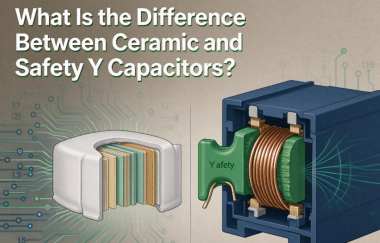
Ceramic capacitors and safety Y capacitors are commonly used in electronic devices, including power supplies, communication equipment, and industrial control systems. Although they share some structural and application similarities, they differ in their classification, design purposes, and safety requirements. This article briefly introduces their characteristics and key differences.
Catalog
I. What Is a Ceramic Capacitor?
II. What Is a Safety Y Capacitor?
III. What Are the Differences Between Ceramic Capacitors and Safety Y Capacitors?
I. What Is a Ceramic Capacitor?
A ceramic capacitor is a type of capacitor that uses ceramic material as its dielectric and metal as its electrodes. A common type, the multilayer ceramic capacitor (MLCC), consists of alternating layers of ceramic dielectric material and internal metal electrodes.
Ceramic capacitors are compact, non-polarized, and offer good high-frequency performance. They are widely used in consumer electronics, communication equipment, automotive electronics, and industrial control systems. Their main applications include filtering, decoupling, bypassing, and signal processing.
Based on their dielectric characteristics, common ceramic capacitor types include C0G (NP0), X7R, and X5R. These types differ in temperature stability, capacitance characteristics, and DC bias performance. You should always refer to the manufacturer's datasheet when selecting a suitable capacitor.
II. What Is a Safety Y Capacitor?
A safety Y capacitor is a capacitor designed to meet relevant electrical safety standards. It is primarily used in AC power circuits to suppress common-mode electromagnetic interference (EMI). It is typically connected between AC power lines and protective earth, or between circuit nodes where the applicable safety standards permit its use.
Compared with general-purpose capacitors, safety Y capacitors have stricter requirements for insulation, voltage withstand capability, and failure safety. Under the IEC 60384-14:2023 standard, Y capacitors are classified into Y1, Y2, and Y4 categories. Each category has different insulation requirements and applicable conditions. The appropriate type must be selected according to the circuit design and relevant safety standards.
It is important to note that safety Y capacitors do not rely on internal fuses to provide electrical safety protection. Their safety performance primarily depends on the materials, insulation structure, manufacturing processes, and relevant safety certifications. In addition, some safety Y capacitors use ceramic dielectric materials.
III. What Are the Differences Between Ceramic Capacitors and Safety Y Capacitors?
Different Classification Methods: Ceramic capacitors are classified according to their dielectric materials, while safety Y capacitors are classified according to their electrical safety applications and relevant standards. Therefore, these two categories are not mutually exclusive.
Different Structures and Safety Requirements: General-purpose ceramic capacitors are primarily evaluated based on capacitance, rated voltage, temperature characteristics, and dielectric losses. In addition to basic electrical performance, safety Y capacitors must meet specific insulation, voltage withstand, and safety certification requirements.
Different Applications: Ceramic capacitors are mainly used for filtering, decoupling, bypassing, and signal processing in smartphones, computers, automotive electronics, and industrial equipment. Safety Y capacitors are commonly used in switching power supplies, chargers, and household appliances to suppress common-mode interference.
Different Selection Requirements: When selecting ceramic capacitors, you should consider capacitance, rated voltage, and temperature characteristics. For safety Y capacitors, you must also consider the Y safety class, certification requirements, and circuit insulation conditions. A general-purpose ceramic capacitor cannot replace a safety Y capacitor simply because their capacitance and rated voltage are the same.
IV. Conclusion
The main differences between ceramic capacitors and safety Y capacitors lie in their classification, design purposes, and safety requirements. Ceramic capacitors are primarily defined by their dielectric materials and electrical characteristics, whereas safety Y capacitors are designed to meet electrical safety requirements and suppress electromagnetic interference. Since some safety Y capacitors also use ceramic dielectric materials, the two categories are not entirely separate. In practical applications, if a circuit requires a safety Y capacitor, you must use a product that complies with the relevant safety standards rather than directly replacing it with a general-purpose ceramic capacitor.


