
What Is the Difference Between Start and Run Capacitors?


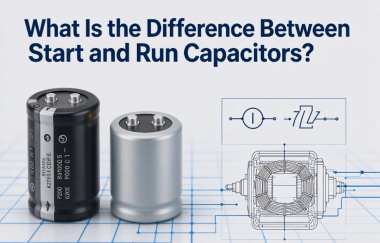
In the electronics industry, start capacitors and run capacitors are commonly used in single-phase AC motors to improve starting and running performance. Both types help generate a rotating magnetic field by adjusting the phase relationship between the currents in the auxiliary and main windings. However, they differ significantly in their operating principles, primary functions, capacitance values, and applications. Understanding these differences is essential for selecting the right capacitor and preventing motor starting difficulties, abnormal operation, or component damage caused by improper selection.
Catalog
III. Differences Between Start Capacitors and Run Capacitors
I. What Is a Start Capacitor?
A start capacitor is a type of capacitor primarily used during the starting process of a single-phase AC motor. Since a single-phase AC power supply cannot directly produce a rotating magnetic field, some single-phase motors require an auxiliary winding and a start capacitor to establish a phase difference and generate starting torque.
A start capacitor changes the phase of the current flowing through the auxiliary winding, creating an appropriate phase difference between the auxiliary and main winding currents. This allows the motor to generate sufficient starting torque and start rotating smoothly.
Start capacitors typically have relatively high capacitance values. They are commonly used in air conditioning compressors, refrigeration equipment, water pumps, and other single-phase motors that require high starting torque. A start capacitor generally operates only during the starting phase. Once the motor reaches a certain speed, it is automatically disconnected from the circuit by a centrifugal switch, starting relay, or other control device to prevent overheating or damage caused by prolonged operation.
II. What Is a Run Capacitor?
A run capacitor is a type of capacitor that remains connected to the circuit while the motor is operating. Its primary function is to improve the phase relationship between the auxiliary and main winding currents, helping the single-phase motor maintain a stable rotating magnetic field.
Unlike a start capacitor, a run capacitor not only participates in the motor-starting process but also remains active throughout normal operation. It helps maintain motor running torque, improve power factor, and optimize overall operating performance. Its specific functions and parameters depend on the motor design and operating conditions.
Run capacitors are generally designed with film capacitor structures suitable for continuous AC operation. They offer good thermal stability and long-term operating reliability and are commonly found in fans, air conditioning compressors, water pumps, and certain washing machines.
III. Differences Between Start Capacitors and Run Capacitors
Although both start capacitors and run capacitors are used in single-phase AC motors, they differ in several important aspects.
(1) Different Functions
A start capacitor primarily increases the starting torque of a motor, helping it overcome the load resistance during startup. A run capacitor primarily supports normal motor operation by improving the phase relationship between the main and auxiliary winding currents, allowing the motor to maintain stable operation.
(2) Different Capacitance Values
Start capacitors generally have higher capacitance values to provide the additional starting torque required by the motor. Run capacitors typically have lower capacitance values and must be matched to the motor's rated power, winding parameters, and operating conditions. The specific capacitance value should always follow the motor manufacturer's specifications.
(3) Different Operating Times
A start capacitor typically operates for a short period during motor startup and is disconnected from the circuit once the motor reaches the required speed. In contrast, a run capacitor remains connected throughout motor operation, so it must provide reliable performance and withstand continuous operation over an extended period.
(4) Different Structures and Rated Parameters
Start capacitors are generally designed for short-term, intermittent operation. Common types include AC electrolytic start capacitors. Run capacitors typically use metallized polypropylene film construction, offering good thermal stability and suitability for continuous AC operation. The two types differ in rated voltage, capacitance, and permissible operating duration. Therefore, they should not be considered interchangeable based solely on their appearance or capacitance values.
(5) Different Applications
Start capacitors are primarily used in single-phase AC motors that require high starting torque, such as certain air conditioning compressors, refrigeration equipment, and water pumps. Run capacitors are commonly found in single-phase motors that use capacitor-run configurations, including fans, air conditioning compressors, water pumps, and certain washing machines. The type of capacitor required depends on the motor's design and starting method.
IV. Conclusion
The main differences between start capacitors and run capacitors lie in their functions and operating modes. A start capacitor primarily increases motor starting torque and typically operates only for a short period during startup. A run capacitor, on the other hand, improves the phase relationship between the auxiliary and main winding currents, helping the motor maintain stable operation throughout its operating cycle.
When selecting a capacitor, it is important to consider the motor's design requirements, including capacitance, rated voltage, operating frequency, duty cycle, and installation conditions. In particular, start capacitors and run capacitors should not be used interchangeably without confirming compatibility. Incorrect selection may cause motor starting failures, abnormal operation, or capacitor overheating and damage. Choosing a capacitor that meets the equipment manufacturer's specifications is essential for ensuring safe and reliable motor operation.


