
What Causes CBB Capacitor Breakdown?


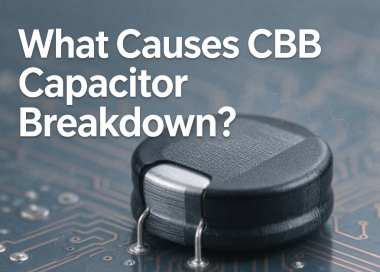
In the electronic components industry, CBB capacitors are a common type of polypropylene film capacitor. They offer low dielectric losses, good insulation properties, relatively high voltage resistance, and excellent stability. These characteristics make them widely used in power supplies, filtering, coupling, resonant circuits, and motor drive applications. However, during actual operation, CBB capacitors may experience dielectric breakdown, capacitance loss, or even short-circuit failures, affecting the normal operation of electronic circuits. So, why do CBB capacitors break down? What are the most common causes? Understanding their failure mechanisms can help engineers optimize circuit designs, select appropriate components, and extend capacitor service life.
Catalog
II. How Do CBB Capacitors Work?
III. What Causes CBB Capacitors to Break Down?
I. What Is a CBB Capacitor?
A CBB capacitor is a type of film capacitor that uses polypropylene (PP) film as its dielectric material. Common types include metallized polypropylene film capacitors and metal foil polypropylene film capacitors. Their basic structure consists of polypropylene film as the insulating dielectric, combined with metallized electrodes or metal foils to form the capacitor element, which is then wound and encapsulated.
Polypropylene film offers high insulation resistance, low dielectric loss, and excellent electrical properties, allowing CBB capacitors to operate in various AC and DC circuits. However, different models have different ratings for voltage, capacitance, operating temperature, and pulse-handling capability. Therefore, engineers should select the appropriate specifications according to the requirements of the application.
II. How Do CBB Capacitors Work?
CBB capacitors store electrical energy through an electric field. When voltage is applied across the capacitor, an electric field forms between the two electrodes. The polypropylene dielectric becomes polarized, allowing electric charges to accumulate on the respective electrodes and enabling the capacitor to store energy.
When the applied voltage changes, the capacitor undergoes charging and discharging. In a resistive charging and discharging circuit, the charging and discharging speed is primarily determined by the circuit's time constant, which is the product of resistance and capacitance. Based on this operating principle, CBB capacitors are widely used in filtering, coupling, bypassing, voltage spike suppression, and reactive power compensation applications.
Under normal operating conditions, the polypropylene film prevents direct current from flowing between the two electrodes. However, when the local electric field strength exceeds the dielectric material's withstand capability, electrical breakdown may occur, resulting in reduced performance or complete capacitor failure.
III. What Causes CBB Capacitors to Break Down?
1. Operating Voltage Exceeds the Rated Value
Overvoltage is one of the major causes of dielectric breakdown in CBB capacitors. When the actual voltage across a capacitor exceeds its rated voltage withstand capability, the electric field strength inside the polypropylene film may exceed the dielectric's insulation limit, resulting in breakdown.
In addition, voltage surges, switching transients, and back electromotive forces generated by inductive loads may expose the capacitor to unexpected electrical stress. Therefore, component selection should account for both the normal operating voltage and transient overvoltage conditions.
2. Poor Capacitor Quality
Raw material quality and manufacturing processes directly affect the insulation performance of CBB capacitors. If the polypropylene film contains impurities, pinholes, or uneven thickness, or if the metallization, winding, or end-contact processes are defective, localized electric field concentrations may develop, increasing the risk of dielectric breakdown.
To reduce this risk, engineers should choose products from manufacturers with reliable quality control systems and verify that the capacitor specifications meet the actual operating requirements.
3. Excessively High Operating Temperature
Temperature is an important factor affecting the service life and reliability of CBB capacitors. Prolonged exposure to high temperatures may accelerate the aging of polypropylene film and other internal materials, potentially reducing insulation performance. Meanwhile, excessive ripple current generates internal losses and heat, further increasing the capacitor's thermal stress.
If a capacitor operates beyond its specified temperature range for an extended period, the risk of dielectric breakdown and other failure modes may increase. Therefore, engineers should optimize thermal management and avoid placing capacitors too close to high-temperature components such as power devices.
4. Humidity and Environmental Factors
Prolonged exposure to high humidity, dust, or corrosive gases may affect the external insulation, terminals, and encapsulation of a capacitor. This is particularly concerning when the sealing performance is inadequate or the protection level is unsuitable for the operating environment, as it may increase the risk of insulation deterioration and corrosion-related failures.
Therefore, CBB capacitors used in humid, high-temperature, or corrosive environments should have appropriate environmental resistance. Additional moisture protection and other necessary protective measures should also be implemented.
5. Improper Circuit Design and Installation
Improper circuit design can also contribute to CBB capacitor breakdown. For example, ripple current exceeding the rated limit, excessive pulse current, or excessive current stress in high-frequency applications may cause localized heating and dielectric damage.
Furthermore, excessive bending of capacitor leads, soldering temperatures or durations beyond the manufacturer's specifications, and mechanical impacts during installation may damage the internal structure and reduce product reliability. Therefore, installation and soldering should always follow the manufacturer's technical guidelines.
IV. Conclusion
CBB capacitor breakdown is generally associated with several factors, including overvoltage, product quality issues, excessive operating temperature, environmental conditions, and improper circuit design or installation. In practical applications, engineers should consider not only the rated voltage but also ripple current, pulse-handling capability, operating temperature, and environmental conditions.
To reduce the risk of CBB capacitor breakdown, engineers should select appropriate capacitor specifications, control voltage and current stress, optimize circuit thermal management, and follow the manufacturer's installation requirements. Proper component selection and standardized usage can improve the operational reliability of CBB capacitors and extend their service life.


